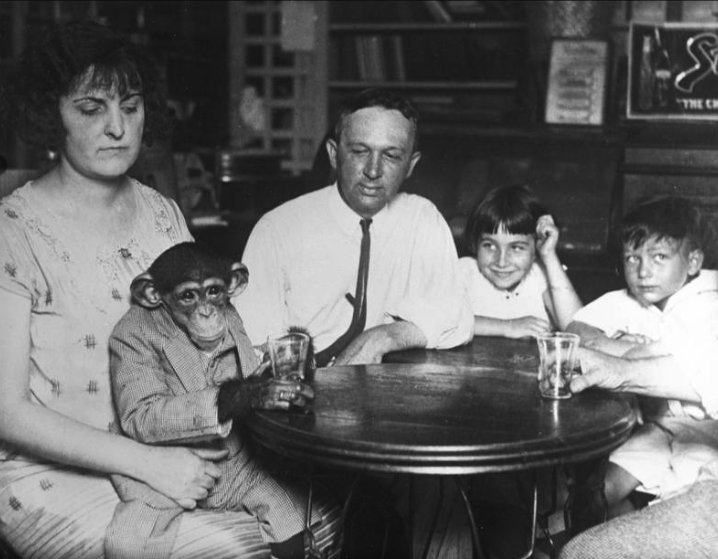
One hundred years ago come July, a trial in little Dayton, Tennessee captured the world’s attention.
It was hot as blazes, so the whole show moved outdoors. The atmosphere was far more fairground than hallowed ground: little girls played with monkey dolls and vendors hawked sodas and souvenirs.
A chimpanzee named Joe Mendi, smartly dressed in a three-piece suit and a fedora, sipped a Coca-Cola at the local drugstore.
The Scopes Monkey Trial was a set-up from the beginning. It was a carefully planned publicity event – an alliance between the civic leaders of Dayton and the American Civil Liberties Union.
Dayton wanted the publicity; the ACLU wanted a case that could be appealed to the Supreme Court of the United States.
High School teacher John Scopes was easily convicted, but not for teaching evolution. Scopes was convicted of violating Tennessee’s Butler Act, a law forbidding the teaching of human evolution. The case was overturned in a lower court, so it never made it to SCOTUS.
And here we are, in the Year of Our Lord 2025, one hundred years later…
State lawmakers and state and local school boards across the nation routinely introduce science education initiatives unsupported by actual scientists, or actual science evidence, for that matter.
Not to be outdone, a local school board in Texas went a step further and banned chapters within adopted science texts. Nothing to see here in chapter 7, kids. Close your eyes and flip to Chapter 8.
OBSERVATION #1: no one is wearing a “Science is Dumb” t-shirt. We all want to be on Team Science.
Occasionally, the anti-science effort is overt: teachers must include intelligent design creationism along with lessons about evolution; or, in the case of West Virginia, the Bible must be recognized as an accurate resource for teaching natural history.
Usually, however, the anti-science initiatives are more subtle. Usually, anti-science initiatives are cloaked in science-y language.
The science-y sounding initiatives demand that “both sides” of a science issue be taught and/or “strengths and weaknesses” of a science theory must be discussed.
No one, however, actually wants to teach “both sides” of photosynthesis. No one wants to critique the water cycle.
No one. Something else is going on.
OBSERVATION #2: Grandstanding is a thing.
Anti-science bills often never reach the floor for a vote. These bills usually die in committee or die without action on the governor’s desk.
Oklahoma, Minnesota, West Virginia, New Jersey, and North Dakota – all had anti-science bills eliminated by inaction.
Is it avoidance of being on record?
A vote for an anti-science measure invites experts to inundate you with actual facts. And in states like Oklahoma and Texas, a vote supporting science likely means you’ll be primaried or defeated.
Sometimes, anti-science still wins:
- Science chapters within adopted textbooks are still banned in the enormous Cy-Fair ISD in Texas.
- Tennessee’s 21st century “monkey law” has been on the books since 2012.
I’ll say the quiet part out loud. The science we want to debate is evolution.
Where’s Joe Mendi when you need him?
We also don’t like vaccines. And we really don’t like climate science.
One hundred years ago, the Scopes trial wasn’t about evidence. In fact, no scientist testified, and no evidence was admitted into testimony.
John Scopes was convicted because evolution was a front in a culture war.
And one hundred years later, opposition to evolution, climate science, and vaccine science is not about evidence.
It’s still a culture war.

 Janet K. Ray