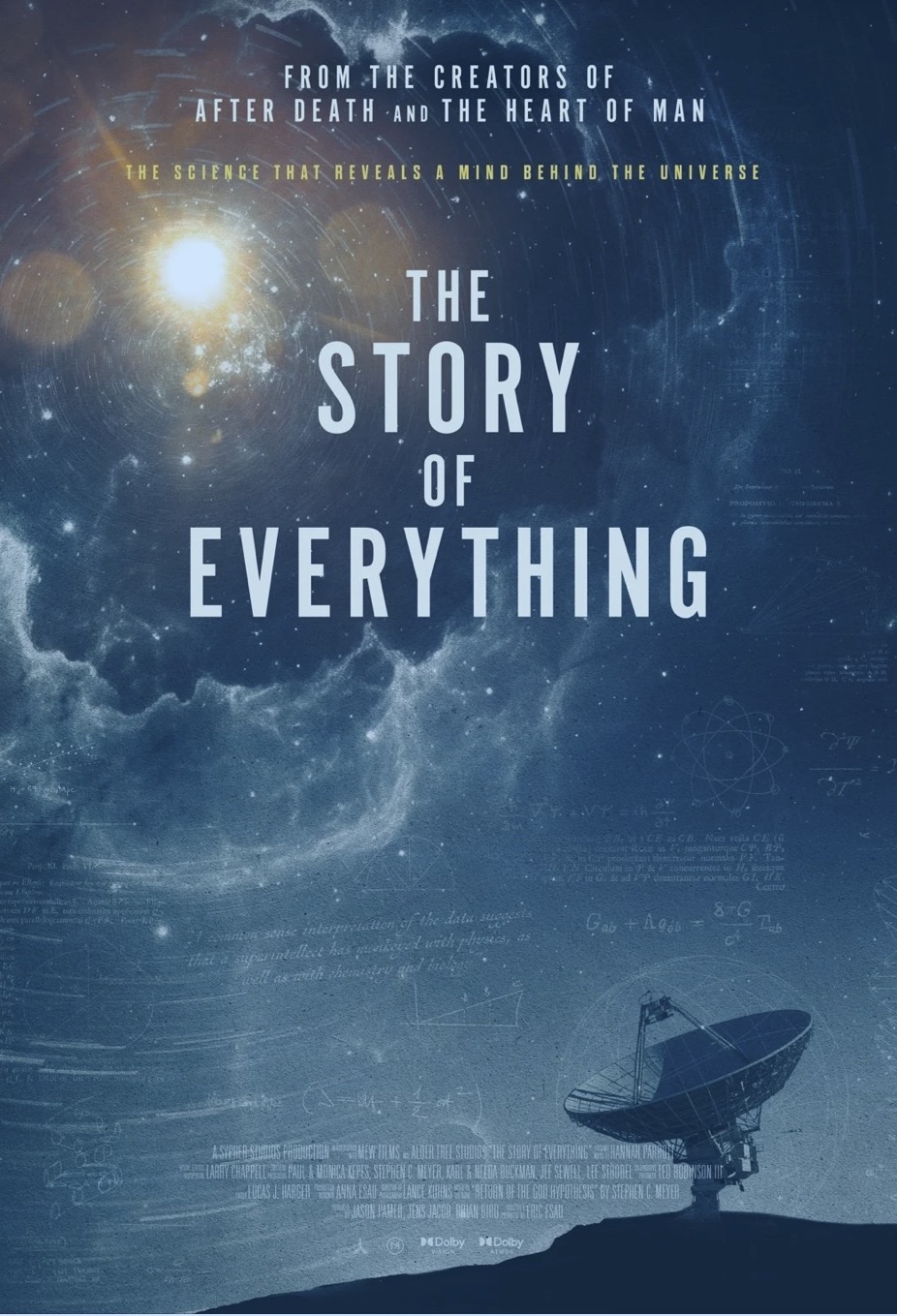
Is our universe the result of an indifferent, meaningless, purposeless accident?
The Story of Everything, a new film with limited theater release, says no.
The film is hosted by Stephen Meyer, a philosopher of science and longtime star of “intelligent design”.
Note: “Intelligent Design” is not a concept separate from creationism, rather, Intelligent Design is a way of explaining creationism, an approach infused with lots of science-y jargon. And like young and old earth creationism, intelligent design assumes a micromanaging creator.
The film is very well made, and animations of physical and biochemical processes are impressive.
The Story of Everything opens with an argument that no one is making: “Science disproves God.”
Actually, the existence of God is not a question for science. Science addresses the questions of “how” and “when.”
Science has nothing to say about “who” and “why.” Yet, the film is entirely devoted to “proving” God via science evidence.
Origin of the universe is the theme of the first half; origin of life the theme of the second.
Life is my wheelhouse, so I’ll focus there.
“If it could be demonstrated that any complex organ existed which could not be formed by numerous, successive, slight modifications,” wrote Charles Darwin, “my theory would absolutely break down.”
Darwin lived, wrote, and died a hundred years before we knew anything about genetics. Yet, the film throws the poor guy under the bus for what he could not have known.
And who is the star witness for evolution’s failure? The bacterial flagellum, of course.
Reality: the “irreducible complexity” of the bacterial flagellum has been debunked for more than two decades.
The film relies excessively on arguments from incredulity. . . in other words, if I don’t understand it, it must be impossible.
How, for example, could the components of DNA randomly self-organize to code for the vast diversity of life on our planet? A roomful of typing monkeys could never reproduce Shakespeare!
Yet, if we lock in a letter whenever the monkeys get it right, those monkeys can reproduce the entirety of Hamlet in 4.5 days.
Physics and chemistry constrain biology. The organization of macromolecules like DNA is not random.
The Story of Everything closes with the beauty argument.
Look at the world! Extravagance and beauty as far as the eye can see! Unnecessary beauty. More beauty than needed for survival.
Surely such gratuitous beauty points to a designer. According to narrator Stephen Meyer, beauty is a “huge problem” for evolution.
What the film doesn’t consider is the other side of the coin … Ugly creatures. Cruelty in nature. Deadly designs.
- The jewel wasp lays its eggs inside a trapped cockroach so its larva can literally feast on the living insect from the inside.
- The naked mole rat. Only his momma thinks he’s cute.
- Childbirth through the pelvis frequently meant death for mothers and babies for much of human history
- Shared space for breathing and swallowing tubes risks choking and death
- The genetic mutation that protects against malaria causes deadly sickle cell disease
Arguing for an intelligent, benevolent designer demands a look at the ugly side of the coin.
Can rational reasons be made for belief in God? I think so.
But we lose credibility when we ignore empirical evidence. We do faith no favors by making bad arguments.
Contrary to the message of The Story of Everything, we do not have to choose between accepting evolution and believing that life has purpose and meaning.
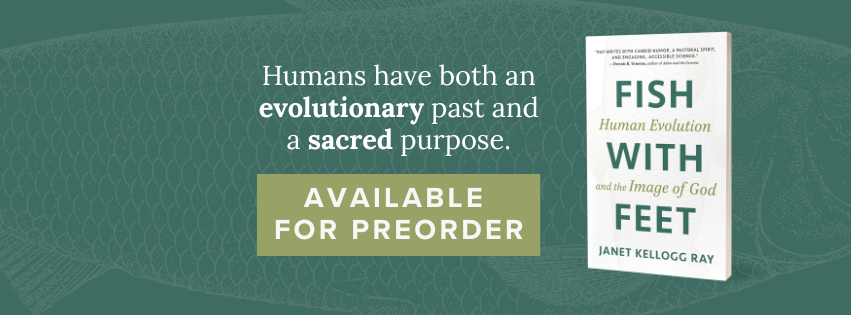


Sounds like it out to sell. Put me down for one.
I’m no fan of the Discovery Institute’s concept of ‘Intelligent Design’, but I did a double-take when I read your line “The Story of Everything opens with an argument that no one is making: “Science disproves God.” “
I encounter that ridiculous claim almost every day, and usually several times a day. Some people that I encounter hold that belief so dogmatically that they tell me that I stopped being “a real scientist’ when I became a Christian, and not even a list of Nobel laureates who are professing Christians makes a dent in their absolute certainty that science and faith are mutually exclusive. 🙄
Good point, I probably should have said “no serious research would done on such a claim (either pro or con existence of) because the claim is not falsifiable.” If someone holds that position dogmatically, I’d ask for the research. It’s an argument that no one is making seriously and doing peer-reviewed research on the premise.
More often I hear the opposite – a person of faith can’t be a scientist (at least not a scientist who accepts evolution). Some of my university students buy into that position. A UK science guy I know says people goad him for being a Christian in his circles, but nobody claims it’s a question for science.