An Identity Crisis and a Cosmic Jerry Springer (Reading Genesis, part 3)

They were supposed to be God’s chosen people, a light to the nations.

They were supposed to have possession of a land.

They were supposed to worship in a glorious temple.

They were supposed to have a son of David on the throne forever.

Instead, they were carted off in humiliation, their capital and temple in ruins. Instead of being a light to the nations, they were ridiculed by them. David’s dynasty was dead and buried, and never again would a son of David sit on Israel’s actual throne.

The exile to Babylon was the most traumatic event in Israel’s national history. The returned exiles, joining the rag-tag survivors who weren’t carried off, struggled with national self-identity:

“Who are we? Are we still the people of God? After all these years and after everything that’s happen to us, are we still connected to the Israelites of old – the people to whom God spoke and covenanted?”

Post-exile Israel wanted identity. They wanted restoration. If they could not go back to the glorious past, they would bring the glorious past into the miserable present.

It was in this context that the Old Testament as we know it took shape. Oral traditions, ancient records, documents and liturgies were compiled and organized into the “books” of the Old Testament. The experience of the exile framed and interpreted Israel’s ancient stories.

The Old Testament is not history in the sense that twenty-first century people understand history. It is instead:

… a document of self-definition and spiritual encouragement: “Do not forget where we have been. Do not forget who we are – the people of God.” (Peter Enns, The Evolution of Adam).

Ancient Stories

As far back as two hundred years before Christ, biblical interpreters realized that the first five books of the Old Testament, specifically Genesis, did not come down to us composed of whole cloth. Multiple, often contradictory versions of stories in Genesis have made Bible students dig deeply for centuries.

Trying to force a modern understanding of science into ancient documents misses lots of boats. Not only do we miss the message intended by the original authors and compilers, we also force the Bible to be something it is not – a scientifically accurate natural history of the earth.

The mid-nineteenth century was an uncomfortable time for Christians. Archaeologists unearthed documents with creation stories and flood stories from the ancient near-east, eerily similar to Genesis but predating Genesis by millennia. And in the same ten-year span, Charles Darwin added insult to injury when he demonstrated that humans share a common ancestry with all life.

But modern science wasn’t going to go away, and neither was the archaeological evidence.

The people and the nation of Israel did not spring up isolated on an island. Israel grew and developed surrounded by its near-eastern neighbors. Israel shared similarities in language, governing, family structure, agricultural practices, and understandings of how the world worked with all of the other Mesopotamian people of that time.

Why should Israel be different? Why would Israel, unlike everyone else in the world, escape the cultural influence of its neighbors?

The stories of Israel are similar to the creation stories of other Mesopotamian people because they share a common culture and a common framework for understanding the nuts and bolts of how the world began.

An Ancient Framework
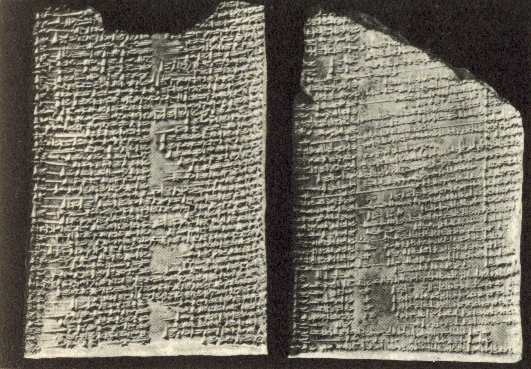
enumaelishLike Genesis, the ancient Babylonian creation story, Enuma Elish, begins with watery chaos. The divine spirit in both Enuma Elish and Genesis exists independently of matter. In both creation stories, darkness precedes creation. In both, light is created before the sun, moon, and stars.

In Enuma Elish, the goddess Tiamat represents the chaos. The word for chaos in the Hebrew of Genesis is linguistically similar to Tiamat.

In Enuma Elish, Marduk is the king of the gods and creator of human beings, and he is also Tiamat’s great-great grandson. After lots of loud inter-god family fights, throwing chairs and plotting revenge, Marduk “tames” the chaos (Tiamat) by slicing her body in half. Marduk then uses half of her body to hold back the waters, creating the heavens and the earth. In Genesis, God creates a solid dome (the firmament) to hold the waters in place.

Enuma Elish is also like Genesis in the order of creation of dry land, the sun, moon, stars, and humans, all followed by a time of rest. Enuma Elish is written on seven tablets; the Genesis story occurs in seven days.

Israel, as a people of its time and culture, understood beginnings according to this framework, but told the story differently. Israel told the story differently because they were the people of God – the true Creator God.

To the ancient Babylonians, cosmic matter always existed. The gods arose from that matter and created the earth. Israel told the story of an eternal God who existed before matter and who brought matter into being from nothing.

There is no cosmic battle between warring gods in Genesis: God tames the chaos, but chaos is impersonal, not a god or goddess.  God alone created the world by an act of his sovereign will, not as the result of a Jerry Springer-like family feud. 

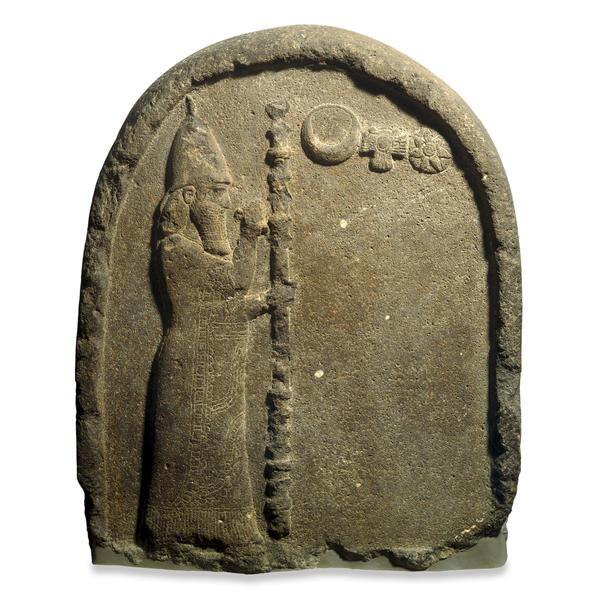
Most ancient people personified and worshiped the sun, the moon, and the stars. They personified and worshiped animals, rivers, and groves of trees. They worshiped kings and mighty men as gods.
stelaofnabonidusane90837

But not Israel. The story told by Israel declares that there is one creator God of all. The sun, the river, and the Pharaoh are not gods – they were created by God.

Genesis and Science

If we want to have a meaningful conversation between evolution and Christianity, we must hear Genesis in its ancient voice, not impose upon it questions it will not answer or burdens it will not bear (P. Enns, The Evolution of Adam).

If the Genesis creation story is literally true, all of modern science collapses – not just biology.

If we try to “read between the lines” of Genesis to find modern science (a la Intelligent Design), we are still trying to make Genesis something it is not.

Genesis cannot bear the burden of modern science because it isn’t science.

 The Big (Church) Chill

When you look at who’s going to church in America and who’s not, right now the fastest growing group are those who have been active church-goers in the past but are no longer in a church. In their just-published book Churchless (2014) the Barna Group calls this demographic the “de-churched”. Currently, one third of Americans are “de-churched”.
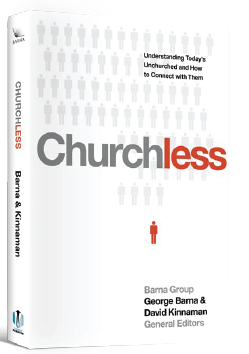
churchless-coverThe reasons for de-churching are varied and nuanced, but “the church is antagonistic to science” is a consistent theme. Young adult dropouts (and older ones as well) believe that the church is out of step with modern science and even anti-science. Young adults struggle to reconcile their faith with a desire to enter a science-related profession.

The de-churched are having their own sort of identity crisis:

“Who are we? In light of modern science, can we still be the people of God? 

The drop-outs aren’t looking for quippy, confident answers about believing God rather than scientists – they are “seeking an honest conversation about reality” (Churchless, 2014).

An honest conversation about Genesis would be a good start. The Genesis creation story can be truth without being factually true.

***************

I believe that the heavens declare the glory of God.

I believe that day after day the cosmos pours forth speech and

night after night the cosmos reveals knowledge.

I trust that the evidence and knowledge that is revealed is true because

the Creator of the cosmos is Truth.

***************


The Gungor Conundrum and a Showdown in Big D (Reading Genesis, part 1)

Grammy-nominated and Dove Award-winning Christian singer/song writer Michael Gungor (front man for the band Gungor) is in hot water. A church cancelled a September gig and Ken Ham is really, really mad at him.

shorefire.com/client/michael-gungor

shorefire.com/client/michael-gungor

There have been quiet rumblings about Gungor before, but following a February post on the band’s home page, suspicions picked up steam. An on-line response by the e-magazine World to Gungor’s post quickly made the internet rounds.

According to World, Michael Gungor, creator of beautiful, deeply spiritual, award-winning Christian music, is “drifting from Biblical orthodoxy”.

Because he no longer believes in God or in Jesus as the son of God?
No.
Because he no longer believes that the Bible is God-breathed and useful?
No.
Because he no longer believes in miracles or the resurrection of Jesus?
No.
According to his critics, Michael Gungor is drifting from the foundational principles of Christianity because he doesn’t believe in a literal, seven-day young earth creation or in a literal, world-wide flood.

Literalists assumed that because Gungor and his band sing a lot about “creation”, they must be young-earth creationists. Gungor’s response: “Gungor is not, and has never been a fundamentalist band seeking to spread young-earth, biblical literalism across the planet”.

It Says What It Says

Michael Gungor is in hot water and accused of unorthodoxy because he doesn’t read Genesis 1-11 as a literal, historical recounting of events. Actually, a literal-only approach to the Bible is a fairly new development in the 2000+ year history of Christianity.

Important theological writers in the early centuries of the church did not insist on a “it says what it says” approach to scripture interpretation. Of course early church writers did not recognize the conflict between modern science and a literal reading, but they still were not literalists.

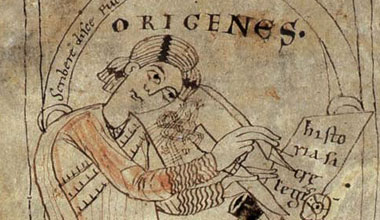
Origen

Origen of Alexandria (born 184/85 AD) was a brilliant and influential voice in early Christianity. During Origen’s lifetime, the church in Alexandria emerged as a theological and intellectual hub of Christianity.

One of Origen’s most important contributions was the publication of a Greek translation of the Old Testament. Origen used the earliest Greek translation (the Septuagint) as well as newer Greek translations and older Hebrew translations in his massive Old Testament work. Origen was the first Christian scholar to deal with the variations found in multiple translations of scripture and how those variations impacted the meaning of the scripture.

Origen also taught that scriptures were multi-layered and the student of scripture must drill down and unpack all the meaning found within. Interestingly, Origen developed this approach to scripture in response to early unorthodox teachings (heresies), particularly the Gnostic teachers. It was the Gnostics (the unorthodox) who were reading scripture in a literal and “it says what it says” way. Purely literal readings of the Old Testament lead the Gnostics to teach that God was petty, erratic, and had a physical body.

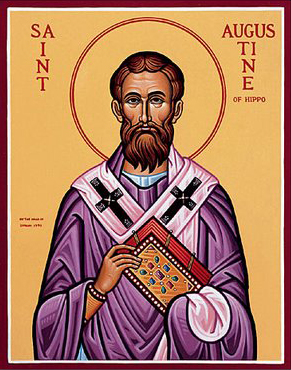
Augustine

Augustine of Hippo (born 354) is considered by many to be one of the most influential Christian thinkers in history. He was a prolific writer and was profoundly influential on the protestant reformers.

Augustine was definitive on this point: although God speaks to the Church through scripture, the Word of God is Jesus Christ. Like Origen, Augustine taught that scripture is multi-layered in meaning. Augustine also insisted that the original intent of the Biblical authors be considered.

Augustine and the Genesis Creation Story

Augustine wrote extensively and specifically about the creation story in Genesis.  Augustine did not read the creation story literally – not because he wanted to accommodate modern science, but because the text did not demand a literal reading.

Augustine rejected the notion that God created the universe in six 24-hour days. According to Augustine, the entire universe was created in an instant and the creation story is a metaphor describing various dimensions of creation.

Although he lived many centuries before Darwin and modern science, Augustine cautioned Christians not to harm the gospel message by imposing meanings to scripture that are demonstrably untrue. Note how contemporary this statement sounds – here’s Augustine:

Usually, even a non-Christian knows something about the earth, the heavens, and the other elements of this world, about the motion and orbit of the stars and even their size and relative positions, about the predictable eclipses of the sun and moon, the cycles of the years and the seasons, about the kinds of animals, shrubs, stones, and so forth, and this knowledge he holds to as being certain from reason and experience. Now, it is a disgraceful and dangerous thing for an infidel to hear a Christian, presumably giving the meaning of Holy Scripture, talking nonsense on these topics…

If they find a Christian mistaken in a field which they themselves know well and hear him maintaining his foolish opinions about our books, how are they going to believe those books in matters concerning the resurrection of the dead, the hope of eternal life, and the kingdom of heaven…?

Showdown in Big D

The Dallas Morning News recently featured nine men, all Ph.D.s, all working toward the same goal: prove, using science, that the Genesis creation story is literally true – a historically and scientifically accurate account. These researchers at Dallas’ Institute for Creation Research are starting out with a belief in literalism and going on a hunt for facts to back them up. ICR

Henry Morris III, CEO of the Institute, readily admits that these professors are pariahs in their fields. Because ICR professors reject evidence accepted by virtually every scientist in the world, it’s a showdown in Big D: ICR vs. science.

Suddenly, Augustine doesn’t sound so fourth-century.

According to Morris, the very principles of Christianity are at stake:

If God really does exist, he shouldn’t be lying to us … And if he’s lying to us right off the bat in the book of Genesis, we’ve got some real problems.

Morris and ICR are laying down the law that a literal Genesis is a requirement of real Christianity.

That’s also why Ken Ham is mad at Gungor:

Gungor’s recent statements are particularly damaging because they may mislead youth and discourage them from accepting the Gospel of salvation.

The Two Books of God

Mark Mann, writing at BioLogos, called creation and scripture the “two books of God”.

The book of Creation reveals God, and declares his eternal power and divine nature.
The book of Scripture reveals God’s relationship with human beings.

Mann writes that the two books of God can and should be read together in harmony:

Ultimately, they cannot contradict each other because the source of both of them is the same God and if they seem to be in contradiction it is because we have misread one or both of them…

***************
I believe that the heavens declare the glory of God.
I believe that day after day the cosmos pours forth speech and night after night the cosmos reveals knowledge.
I trust that the evidence and knowledge that is revealed is true because the Creator of the cosmos is Truth.

wormhole


Nones on the Run and the Lonely Middle Ground

Where were you in ’82? 80s-fashion

In the last thirty-two years (or less), how have you changed? Hopefully your tunes are smaller now and you probably aren’t sporting a sweatband as an accessory.

What about your worldview? Your theology? Have you ever tracked your own thought evolution from childhood to adulthood to where you are now?

Since 1982, Gallup has tracked American beliefs about creationism and evolution. The same questions were asked every two years and the responses tracked:

Which comes closest to your viewpoint?
• God created humans pretty much in their present form sometime within the last 10,000 years (traditional young earth creationism)
• Humans developed over millions of years from less advanced life forms, but God guided this process (evolution and God, sometimes called “evolutionary creation”)
• Humans developed over millions of years from less advanced life forms, but God had no part in the process (atheistic evolution)

Currently, more than forty percent of Americans believe that humans were created in their present form no more than 10,000 years ago – and this percentage has held relatively steady over the last three decades. Respondents who regularly attend worship services and those with a high school education or less were most likely to accept young earth creationism.

The percentage of Americans who believe “God had no part” (atheistic evolution) in human origins is steadily increasing – jumping from nine percent when tracking began in 1982 to nineteen percent this year.

At the edges of the science versus faith conversation are the two extremes: one group has hunkered down and held tight (science is wrong and Genesis is literal); the other has staked out ground and is growing (no role for God in creation).

What about the middle ground – the people who see no conflict between science and faith?
Over the last three decades, the percentage of Americans who believe in evolution and God has held steady – around 38 percent. But in the last four years, the percentage has dropped, and in 2014 was at an all-time low of 31 percent.

cake-eatingConventional wisdom says that if you have the opportunity to have the best of two worlds – if there’s an opportunity to have your cake and eat it – the smart thing to do is to seize it.
Given the opportunity to believe the science learned in school and maintain faith in God as the ultimate cause and source, you’d think the middle ground would be growing, not shrinking.

In the science and faith conversation, the middle ground is no man’s land.

It’s hot lava. HotLava

It’s a mystery. It’s a mystery particularly when contemporary world-class scientists like Francis Collins and Kenneth Miller are enthusiastic defenders of both evolution and faith. It’s a mystery because most evangelical colleges support both evolution and faith (although often on the down-low, behind closed doors in biology class).

Karl Giberson (What’s Driving America’s Evolution Divide) believes that the increase in the “God has no role” percentage tracks directly with the fastest growing religion in the United States: the nones.

One third of Americans under age 30 do not identify with any religion (Nones on the Rise, Pew Research Religion & Public Life Project). Giberson sees the extremist “you can’t believe both” approach to science and faith as a primary factor in the rise of the nones in the young adult demographic:

young American Christians, by the thousands, are rejecting a religion that tells them to reject science. Many respondents to the Gallup survey apparently perceive the choice to be between evolution and God, rather than between evolution-without-God and evolution-with-God.

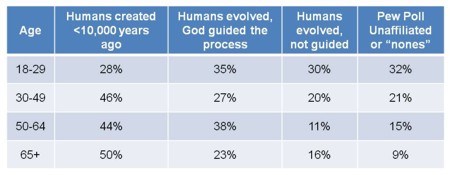
Scot McKnight has a slightly different interpretation of the Gallup data. McKnight points out that in all age groups, unguided evolution tracks pretty closely with the number of “nones” in each group. In the graphic below, McKnight inserted the “nones” data next to the “evolution” data:

Gallup-Poll-on-Evolution-by-age-newApparently the under-30 nones aren’t the only ones rejecting a religion that tells them to reject science.

But contrary to Giberson, McKnight sees a reason for optimism in this fact: the under 30 group is the only group that favors God-guided evolution over young earth/special creation. McKnight is hopeful for the acceptance of “evolutionary creation” in the emerging adult generation.

Why They Left

The five-year study by David Kinnaman and the Barna Group haunts me. Kinnaman studied young adults who, though raised as regular churchgoers, left church after their teens. Kinnaman’s book You Lost Me: Why Young Christians are Leaving Church and Rethinking Church details the study.

Here’s Kinnaman:

No single reason dominated the break-up between church and young adults. Instead, a variety of reasons emerged. Overall, the research uncovered six significant themes why nearly three out of every five young Christians (59%) disconnect either permanently or for an extended period of time from church life after age 15.

And on that list of six significant themes?
This:

Churches come across as antagonistic to science.

Although it is encouraging that more young adults favor “evolutionary creation” over young earth creationism, we can’t ignore the fact that overall, young adults are leaving their faith and fueling the rise of the “nones”.

Take another look at Scot McKnight’s graphic. Gallup-Poll-on-Evolution-by-age-new

Interestingly, it is 30-49 year olds who are rejecting God-guided evolution at a higher rate than younger and older groups. What’s going on there? And how is this group – probably the age demographic of the leadership in most churches – impacting the exit of the young nones?

Claiming the Middle Ground

The extreme voices in the science and faith conversation – Ken Ham, Richard Dawkins – draw honest seekers to the edges, thus the shrinking middle ground. Anything else is defined as either a compromise of faith or of intellect.

What are committed people of faith to do when they want to love God with heart, soul, strength, and mind?

Ignore science? Pretend it isn’t so?

…or, revisit the way we read Genesis.

Deep breath. We’ve done this before.

In light of modern science, Christians revisited what they thought scripture plainly taught about the movement of the earth and sun.

In light of modern science, Christians revisited what they thought scripture plainly taught about the structure of earth’s atmosphere.

In light of modern understanding of human rights and the historical context of scripture, Christians revisited what they thought scripture plainly taught about slavery and most recently, segregation.

What Would it Take?

Toward the end of the Bill Nye – Ken Ham debate, the moderator asked this simple question to each debater: what would it take for you to change your mind?
Nye: evidence.
Ham: nothing.

What is it for you? What questions are you asking? What would you like to see addressed here in this blog? Comments? Evidences?

In your opinion, what is the biggest obstacle to accepting both science and a Christian worldview?
I would like to do a few posts on reading Genesis, and I’m thinking about an “Evolution 101” series covering the basics of evolution science.

Please leave your feedback, your comments, your suggestions!

****************

I believe that the heavens declare the glory of God.
I believe that day after day the cosmos pours forth speech and night after night the cosmos reveals knowledge.
I trust that the evidence and knowledge that is revealed is true because the Creator of the cosmos is Truth.

cat angular momentum

Doubting Science, Changing the Rules

5meIt was, according to one reviewer, a male nerds’ night out—wearing their best Hawaiian shirts and tees boasting superheroes, periodic tables and jokes about Pluto. I was there, too, in my “peace, love, & space” shirt – Dr. Neil deGrasse Tyson, the beautiful Winspear Opera House in Dallas, and three hours of science nirvana.

Seated directly next to my husband and me was a ten year old boy. I know he was ten because when Dr. Tyson noted the number of kids in the audience, he jumped up and down, waved like a windmill and shouted “I’m ten! I’m ten! I’m ten!” In fact, Little Sheldon was on his feet or at the edge of his seat nonstop for three hours – shouting out answers to rhetorical questions, giving full-bodied and full-voiced agreement to Dr. Tyson’s talking points and laughing so loudly at the science humor I thought he would bust a vein. (The comments section for this Dallas Morning News review mentions this kid.  Three tiers in the Winspear and everyone heard him.)

To this boy and all the other enthusiastic kids present, Neil deGrasse Tyson is a rockstar. To the whole audience, really – the show had been sold out for months. Dr. Tyson is funny and engaging and talks like he’s your best friend (if your best friend is an astrophysicist rockstar).

But toward the end of the question and answer time, Dr. Tyson turned somber and confessed his fears about the people outside the walls of the Winspear that night:

I worry for America. We led the world, and the rest of the world would listen in.

Dr. Tyson isn’t the only leading scientist who is worried about America.
Here is the 2013 winner of the Nobel Prize in Medicine, Randy Schekman:

Science ignorance is pervasive in our society. These attitudes are reinforced when some of our leaders are openly antagonistic to established facts.

Doubting Science

A recent Associated Press-GfK poll (March 2014) questioned adult Americans about several science topics. Instead of quizzing science knowledge, the pollsters asked respondents to rate their confidence in various statements of scientific evidence.

Happily, most Americans believe that smoking causes cancer – only four percent are holding out. Only six percent question whether mental illness is a medical condition and only eight percent doubt there is a genetic code inside our cells.

So far, so good – but things go downhill fast from there.

  • Fifteen percent of Americans doubt the safety and effectiveness of childhood vaccines.
  • Forty percent do not believe the earth is warming due in part to man-made trapped gases.
  • Forty-two percent of Americans don’t believe in evolution.
  • Thirty-six percent don’t believe that Earth is 4.5 billion years old.

And a whopping 51 percent of adult Americans doubt that the universe began in the Big Bang.

A new Gallup poll (June 2014) corroborated the AP poll: 42 percent of Americans believe that God created humans, pretty much in their current form within the last 10,000 years.

And in that belief, Americans pretty much stand alone.

Of 34 industrialized countries (32 European countries, USA, and Japan), only Turkey ranks lower than the United States in acceptance of evolution.

What’s the Harm?

If ID/creationism is allowed to share a legitimate scientific spotlight with evolution, the very foundation of the scientific method is undone.

Is that a problem? What’s the harm in remodeling the way we “do” science?

  • Science would be no different than any other human endeavor – subject to political and social opinions.

Does evolution seem to be random and meaningless? Does Intelligent Design/creationism bestow meaning and purpose to creation and to humans particularly?
No worries – just pick the position you prefer! Teach both! Let students decide!

Evolution is just the camel’s nose in this science remodel.

In fewer numbers than evolution-deniers (but growing) are the Americans who believe that vaccines are harmful, despite overwhelming evidence to the contrary. It doesn’t matter to anti-vaxers that science is not on their side. Anecdotal evidence and personal opinion against vaccination trumps all, even in well-educated anti-vaccine enclaves.

When personal philosophy is on equal footing with evidence (whether with evolution or in medicine), reality doesn’t really matter.

  • Supernatural explanations of natural events stifle scientific curiosity and exploration.

Giants of modern science – Galileo, Newton, Einstein – all spoke about God. They speculated as to how God ordered things in the natural world, but never did they add God to a mathematical equation. God was never cited as the reason for the results of a formula or a step in a process.

…if there is one characteristic that has distinguished Western science from every form of inquiry in human history, it is its uncompromising insistence that nature itself must be the source of answers for questions about the natural world (p. 197).

When God is pushed into the gaps of what we don’t know or don’t understand about the natural world, science stops. Why look any further?

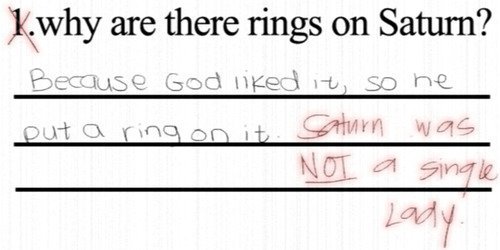
The answer is God.  funny-test-answer-saturn-rings-single-ladiesIf special design is the answer for the complexity found in living things, why study more? There are no patterns or relationships to discover.

And the massive amounts of genetic data collected over the last two decades that indicate the interrelatedness of all life? Just an illusion, no need to develop the new medical treatments indicated by those findings.

  • No policing needed

Traditionally, a new discovery is put out to the open market of the science community. Hypotheses are formed; experiments are conducted. False conclusions are eventually found out – science self-corrects. Over time, findings about a discovery stabilize and a framework of understanding is constructed. Although refinements may be made, once a framework reaches this level, it is considered fact. This framework is called a theory – (atomic theory, gravitational theory, germ theory, and evolution theory are examples).

In the science remodel advocated by Intelligent Design/creationism proponents, science does not need policing. If an idea has value to a significant number of people, that is enough to define the idea as real science. No research or confirmation is needed.

Despite volumes of publications, there is still no peer-reviewed evidence for Intelligent Design/creationism. Intelligent Design/creationism cannot compete on the scientific playing field as-is. If Intelligent Design/creationism is given equal footing in the scientific community and in the classroom, the game must be changed.

Bad Definitions Make a Crummy Debate

Intelligent Design/creationists define evolution as atheistic. Atheists define evolution as atheistic.
Both are wrong.

Evolution is not Christian. Evolution is not un-Christian. Evolution is not conservative or liberal for that matter.

Evolution is science:

Evolution tells us that we have a history on this planet, a history we share with every living organism (p. 220).

Following the Dover Intelligent Design trial, political pundit Charles Krauthammer said this:

How ridiculous to make evolution the enemy of God. What could be more elegant, more simple, more brilliant, more economical, more creative, indeed more divine than a planet with millions of life forms, distinct and yet interactive, all ultimately derived from accumulated variations in a single double-stranded molecule, pliable and fecund enough to give us mollusks and mice, Newton and Einstein? Even if it did give us the Kansas State Board of Education, too.

Elegant, brilliant, creative, divine. As a believer in God, I find nothing in that description to fear.


This series is a chapter by chapter overview of Kenneth R. Miller’s Only a Theory, with my discussion and commentary.

****************

I believe that the heavens declare the glory of God.
I believe that day after day the cosmos pours forth speech and night after night the cosmos reveals knowledge.
I trust that the evidence and knowledge that is revealed is true because the Creator of the cosmos is Truth.

Creationism’s Playbook and the Closing of America’s Scientific Mind

I wrote my first letter to a politician this week. dan
I wrote Dan Patrick, the leading candidate and likely winner in the run for Texas lieutenant governor. I told him that I want Texas to lead in science, medicine, and technology. (In Texas, the lieutenant governor is a legislative leader capable of powerful influence on policy, including public education law).

Here’s Mr. Patrick on science education in Texas public schools:

When it comes to creationism, not only should it be taught, it should be triumphed, it should be heralded.

Mr. Patrick: how can Texas lead if our science classes discard the very basis of modern biology as well as modern physics and geology?

I’m still waiting for a reply.

Science is one of the few things in life unaffected by politics ( p. 167) – there is no such thing as a Democrat Krebs cycle or a Republican explanation of DNA replication.

Even when there are ethical or moral or political issues regarding how science should be applied, the underlying science is unchanged: those who want to ban stem cell research do not claim that stem cells do not exist; those opposed to nuclear weapons still accept atomic theory.

Social sciences, however, are a different story.

In his best-seller The Closing of the American Mind (1987), Allan Bloom scathingly critiqued American higher education. America’s most highly regarded virtue (according to Bloom) is openness.

Academia, specifically in the social sciences, has declared that all customs, all cultures, all philosophies, and all ideas are worthy of consideration. Evidence is not important; reason is not important. The greatest danger in social sciences is not error, but intolerance. If I make a judgment on the basis of evidence, I am not “open” to other ideas and interpretations. According to Bloom, the American mind is closed because it is (ironically) too open.

Here’s Bloom:

The point is not to correct the mistakes and really be right; rather it is not to think you are right at all (The Closing of the American Mind, p.26).

When Bloom published in 1986, he exempted the natural sciences from this trend. Bloom found natural scientists to be ruggedly devoted to empirical evidence, to their use of nature as the ultimate standard of proof:

It (natural science) is really self-sufficient, or almost so…. Natural science does not boast, it is not snobbish. It is genuine.

And I love this declaration:

Natural science simply does not care.

Natural science is the honey badger of academia.

honey badger don't care.

honey badger don’t care.


Enter: “The Wedge”

In 1998, the Discovery Institute (a creationist think tank), guided by University of California – Berkley law professor Phillip Johnson, outlined a strategy designed to overhaul the way science is “done”. To Johnson and the Discovery Institute, modern science was anti-religion. This strategy, essentially the “playbook” for Intelligent Design/ creationism, was called “The Wedge” by its creators. As the name implies, the intent of the strategy was to drive a wedge between science and its natural (materialistic) roots:

Design theory promises to reverse the stifling dominance of the materialist worldview, and to replace it with a science consonant with Christian and theistic convictions (The Wedge).

The Wedge proposed a three-phase plan of action: (1) scientific research and writing, (2) publicity, and (3) cultural confrontation.

Phase 1 has not been successful. No research supporting the Intelligent Design model of creationism has ever been published in a peer-reviewed journal.

Michael Behe, although one of the most prolific writers and proponents of Intelligent Design, testified to the lack of research at the historic trial in Dover, Pennsylvania:

There are no peer-reviewed articles by anyone advocating for intelligent design supported by pertinent experiments or calculations which provide detailed rigorous accounts of how intelligent design of any biological system occurred (Only a Theory, pp. 178-179).

Behe also testified that the darlings of Intelligent Design – the blood clotting cascade, the immune system, and the concept of “irreducible complexity” – had no peer-reviewed support.

And unless you count the Discovery Institute’s own research in its own journal, there is still no peer-reviewed evidence for Intelligent Design’s brand of creationism.

Anything Goes

The Wedge’s phases 2 and 3 (publicity and cultural confrontation), however, have been quite successful.
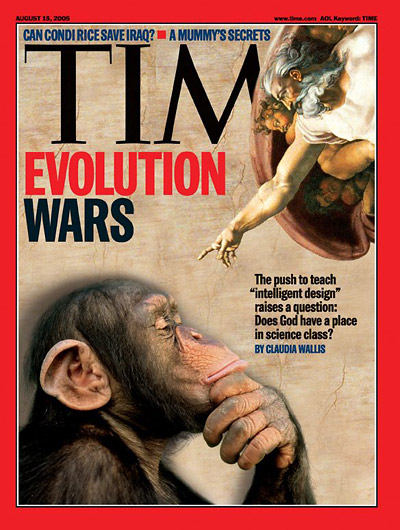
Multiple court cases in many states framed the teaching of evolution in public schools as a “culture-war” issue. A magazine cover time cover and a popular movie  expelledreinforced the believers-against-the-godless-evolutionists mantra.


The message was clear and found its way into education bills across the country: Teach the controversy. Present both sides. Don’t you want our children to be critical thinkers? It’s “only” a theory.

Ironically, Intelligent Design advocates adopted the strategy of left-leaning academics. With Intelligent Design/creationism, natural sciences are subject to the “open to everything” approach that Bloom said had closed the American mind. When scientific evidence no longer matters and when all comers get equal time, the American scientific mind has been closed.

Natural Explanations

Traditionally, scientists try to find natural explanations for natural events. In the world of Intelligent Design/creationism, non-naturalistic explanations get equal consideration.

Let’s follow this line of thinking beyond the topic of evolution….if you break out in a nasty rash, do you want your doctor to divide her diagnostic efforts between looking for a medical cause AND looking for a neighbor who might have cursed you with bad skin? If your house is sinking, do you call an engineer or a ghost-buster? ghostbustersmenAlthough most anti-evolutionists believe that God blesses the earth with rain, they have no problem with teaching the water cycle in public schools. Only in the case of evolution do we find people lobbying for the inclusion of non-natural explanations in science class.

That’s Why Science Works

Here is Dr. Neil deGrasse Tyson in a recent interview, talking about the nature of science:

Once science has been established, once a scientific truth emerges from a consensus of experiments and observations, it is the way of the world. What I’m saying is, when different experiments give you the same result, it is no longer subject to your opinion. That’s the good thing about science: It’s true whether or not you believe in it. That’s why it works.

In my letter to Dan Patrick, I told him that I share his committed Christian faith and his high regard for scripture. I told him that there are a lot of us out here who see no conflict between science and faith. I offered to meet and discuss.

So far no invite.


This series is a chapter by chapter overview of Kenneth R. Miller’s Only a Theory, with my discussion and commentary.

****************

I believe that the heavens declare the glory of God.
I believe that day after day the cosmos pours forth speech and night after night the cosmos reveals knowledge.
I trust that the evidence and knowledge that is revealed is true because the Creator of the cosmos is Truth.

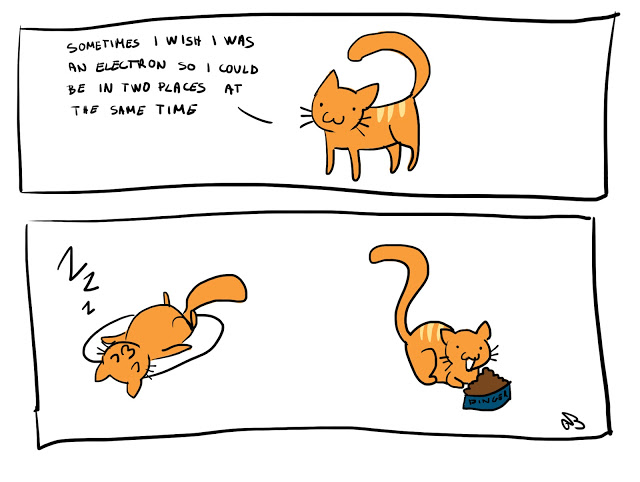
electron cat

Did the World Know We Were Coming?

higgs boson image (2)Call me Sheldon, but Particle Fever is one of the coolest films I’ve seen in a while.
Particle Fever tells the human story behind the recent discovery of the Higgs boson (aka “the God particle”).

My understanding of particle physics is about on the level of the intended audience of Chad Orzel’s book How to Teach Physics to Your Dog, but briefly:

The Higgs boson had been predicted for decades, but never found. For years, theoretical physicists based theories on it and experimental physicists designed machines and experiments to look for it.

Anticipation in the movie builds: If the Higgs boson is found and it has a small numerical value on the scale of The Way Physicists Measure Stuff, this would indicate that matter is organized according to a model called “supersymmetry”. And if the supersymmetry model is true, then physicists know where the Higgs boson fits into the model and can go from there to discover all the other parts and pieces of the model. Yay for science! Things are waiting to be discovered!

BUT if the numerical value for the Higgs boson is large, this would indicate no symmetry in matter – a chaotic, unknowable model with unknowable laws called the “multiverse” model.
Although intrigued by the concept of a multiverse, the young physicists in the film were pulling for supersymmetry. The complete randomness and unknowable-ness of a multiverse was depressing. If the multiverse is true, there would be no reason to continue research and experimentation, no reason to carry on their work, just no reason.

We don’t like random. It depresses us. Evolution-deniers have long defined evolution as a “random” or an “accidental” process. If that’s true, then we are not special, we are just sophisticated animals that accidentally obtained consciousness. We are depressed and deflated, with no hope for the future.

Rick Santorum, former Pennsylvania senator and presidential hopeful said this in a nationally broadcast interview:

It [evolution] has huge consequences for society. I mean, it’s where we come from. Does man have purpose? Is there a purpose for our lives? Or are we just simply, you know, the result of chance? If we are the result of chance, if we’re simply a mistake of nature, then that puts a different moral demand on us – in fact, it doesn’t put a moral demand on us….

Unpredictable VS Random

The process of evolution is unpredictable, but it is not random.

You cannot predict who will win the next Texas Mega-Gazillionaire Lottery. But the winner will not be me – I’ve never bought a ticket. The lottery is unpredictable but it is not random.

cat-in-trendy-strollerThe genes passed down from parents to offspring are unpredictable, but human parents will not produce a kitten or a starfish.
Human genetics are unpredictable, but are not random.

In the case of evolution, changes that occur in living things are not predictable, but neither are they random. Changes in living things are driven in a direction that benefits the evolution of the organism.

Contingency

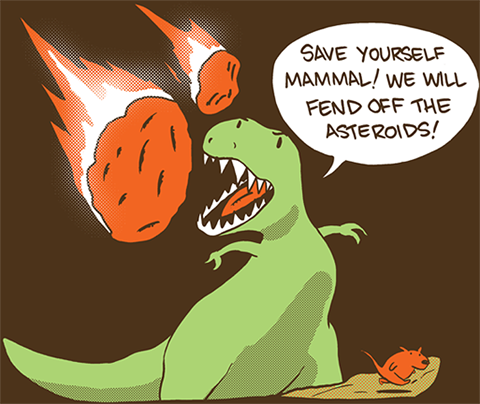
If we rewound the clock of evolution and set it out to run again, would we end up with the exact same natural history of life on earth? Is the process of evolution a contingent process – change one event and the whole picture changes? smbc-dinosave_large_copyfix_grandeFor example, if the asteroid missed the earth on that fateful day and the dinosaurs survived, would mammals have proliferated and advanced as they did, eventually resulting in humans?

The answer is yes and no.

What if your life was rewound back to the moment when your parents’ chromosomes were being shuffled about just before the fertilization occurred that resulted in you?

You would not be the exact person you are today. But – the same genetic constraints that were in place the first time around would still be in place in the rewind. You would still be your parents’ child.

Our universe and our planet are constrained by natural laws of physics and chemistry:

How strong are the constraints imposed by those conditions? To what degree do they guide and determine the course of evolution? (Only a Theory, p. 147).

In simpler words, did the world know that we (in one form or another) were coming?

Convergence

Visualize a watery space where animals might live – an ocean or a lake. Slow moving animals, whether large or small, can be almost any shape. But large, fast-moving animals living in the water tend to have a streamlined shape.

Think about a dolphin (mammal), a tuna (fish), and an ichthyosaur (extinct marine reptile) – all three very different animals. But all three are amazingly similar in shape:

Dolphin

dolphin

tuna

tuna

ichthyosaur

ichthyosaur

This concept is called convergence: organisms that evolve in a particular space will adapt to that space. Organisms evolve features that allow them to live and thrive in a particular environment. As a result, very different and unrelated organisms may look quite similar.

…evolution essentially “explores” any given adaptive space. It pokes and probes the multidimensional landscape of adaptation, and when two or more organisms arrive in a particular niche on that landscape, they are subject to the same physical constraints. (Only a Theory, p. 148)

koala in glassesKoalas, Kangaroos, Eyes, and Convergence

Do You Come From the Land Down Under? When the Australian landmass separated from the rest of the world (about 100 million years ago), it was home to both marsupial mammals (mammals that give birth to very underdeveloped young and carry them in pouches) and placental mammals (mammals that give birth to more developed young). In the newly isolated Australia, only the marsupials survived. In the rest of the world, however, the placentals were champions.

Outside Australia, placental mammals evolved and adapted to a variety of niches. Hunter/predator mammals evolved, as did burrowing mammals and tree-dwelling mammals. The same types of niches found throughout the world were also found in Australia, but only marsupials were around to fill them. In Australia, evolution also produced hunter/predators (the tiger quoll), burrowers (marsupial moles), and tree-dwellers (marsupial flying squirrels).

In Australia, evolution filled the very same spaces with marsupials that it had filled elsewhere with placental mammals.

Eyes Everywhere. Separated by a span of 400 million years, several groups of organisms faced the challenge of vision. Vertebrates, worms, and cephalopod mollusks (squids, octopi, nautilus) all evolved a camera-like eye. These three eyes did not evolve in the same way or from the same structures and are not the same biochemically.
BUT – all three types of eyes are constrained by the same physics of light and geometric principles of optics.

Were We Inevitable?

Again and again, life explores and fills adaptive spaces. Whether separated by oceans or millions of years, the same physical constraints of chemistry and physics are at work, solving problems in similar ways.

Is it reasonable, then, to believe that due to these constraints, the process of evolution would eventually and inevitably lead to us?

…it’s perfectly reasonable to maintain that evolution as we know and understand it was almost certain to produce a species like ours under conditions that prevail on Planet Earth (Only a Theory, p.153).

Life is possible only because of the precise and balanced fundamental constants of our universe. Exact outcomes of the evolutionary process might be unpredictable, but they are not random.

Accident of Nature or Willed by God?

To opponents of evolution, unpredictable is equated with random, and randomness is called God-less.

If God is the cause of causes, people of faith can accept evolution and still believe the universe was willed by God and our presence in it is God’s plan and purpose. The natural processes that brought about life on earth are no more God-less than the natural processes that maintain and propagate life.

God’s Image-bearers

This ad ran on the Answers in Genesis website following a rash of school shootings in 2006: Gun and God

The script reads:

As a society, we reap the consequences of the unquestioned acceptance of the belief in evolution every day. It diminishes your worth and reduces human beings from being made “in the image of God” to being mere players in the game of survival of the fittest.

Evolution makes some people nervous because of the whole connection-to-animals thing. Here’s the thought: how can we be “made in God’s image” if we are just animals?

Peter Enns is the Abram S. Clemens Professor of Biblical Studies at Eastern University and former senior fellow of biblical studies for The BioLogos Foundation. In his book The Evolution of Adam, Dr. Enns explored what the Bible says and does not say about human origins.

In Genesis, the phrase “image of God” does not refer to a characteristic that separates us from all other animals. The “image of God” does not refer to biology or a soul or a spiritual quality that makes us special.

Instead, the term “image of God” describes humans as God’s representatives in ruling creation. The original readers of Genesis would have understood this – ancient Near-Eastern kings declared themselves to be the gods’ image on earth. Kings liked to set up statues of themselves across the kingdom to remind their subjects that they were in charge and appointed by the gods.

In Genesis,  “image of God” means that humans have been tasked with representing God in the world.

That is a daunting task, and it certainly makes us special.


This series is a chapter by chapter overview of Kenneth R. Miller’s Only a Theory, with my discussion and commentary.

****************

I believe that the heavens declare the glory of God.
I believe that day after day the cosmos pours forth speech and night after night the cosmos reveals knowledge.
I trust that the evidence and knowledge that is revealed is true because the Creator of the cosmos is Truth.

CatsDinosaurs


Evolution and Human Beings

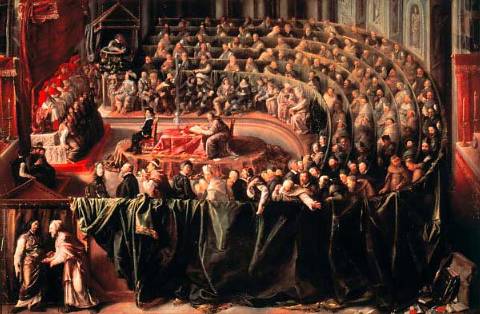
We pronounce, judge, and declare, that you, the said Galileo… have rendered yourself vehemently suspected by this Holy Office of heresy, that is, of having believed and held the doctrine (which is false and contrary to the Holy and Divine Scriptures) that the sun is the center of the world, and that it does not move from east to west, and that the earth does move, and is not the center of the world.

galileoGalileo Galilei, the great astronomer, mathematician, physicist, and telescope whiz was convicted by the Church Inquisition in 1633, threatened with torture, given penance, and sentenced to house arrest for the remainder of his life.

The Galileo story is a useful analogy in contemporary science-versus-faith discussions: in the face of unequivocal scientific evidence, Christians eventually changed long-held interpretations of scripture.

Actually, seventeenth century Christians were not really all that upset about the science that put the sun (instead of the earth) in the center of the solar system.

Of course there were the literalists who were genuinely upset about the Bible verses that said the earth was fixed and unmovable, but that wasn’t the biggest deal. geocentric model

Galileo didn’t hurt the Church’s science feelings as much as he hurt their theological feelings.

  • If the earth is not the center of everything, then man is no longer the central focus of creation.
  • If the earth is just one of innumerable planets in the universe, the earth is not special to God, and therefore man holds no special place in creation.
  •  Adam has no meaning! Noah has no meaning! All of the Christian story is lost!

(Karl Giberson discusses the theological implications of Galileo’s evidence on 17th century belief here).

The Great Sticking Point – the Evolution of Humans

Many Christians, faced with the scientific evidence and unwilling to believe in a vast conspiracy of deceitful scientists, are often willing to accept a very ancient earth and even the evolution of plants and animals.

But humans. That’s a problem.

The arguments against humans as part of the great evolutionary story of life on earth sound very much like the theological arguments of the seventeenth century:

  • If humans are just another branch in the evolutionary tree, we aren’t special to God.
  • What about Adam?
  • If we don’t have a real Adam, there can be no “fall of man”… and without the fall, there’s no need for Jesus.
  • All is lost!

How Can We Reconcile Human Significance and Evolution?

Because evolution is driven to a large degree by random mutations, are human beings just a blind, meaningless accident? In the biological history of the earth, there have been creatures that were vaguely similar to us, some were very similar to us, and some were not even remotely like us (p. 198).

consequences-of-evolution-388

Consider these three ways of looking at human significance in the context of evolution…

A God outside of time: to a Being unbounded by time and existing outside of time, is anything truly random? We have no idea how God and his purposes relate to time. An event that seems absolutely random (such as carbon production inside a distant star billions of years ago) becomes essential to building life on earth.

A God acting in time: if God sustains life through natural laws and processes, could not God create life using natural laws and processes? Genetic mutations are by their very nature unpredictable because they are initiated at the quantum level of the atom. At the quantum level, things are unpredictable, actually unknowable. It is conceivable that God could work undetected within natural laws, within the natural unpredictability of the quantum level and influence the evolution of life.

A God who allows freedom: all of creation, both animate and inanimate, has free will. A third way of understanding is that God has integrated freedom into the evolutionary process. God may have chosen not to specifically direct the winding pathways of evolution (Language of Science and Faith, p. 200), but to let the process unfold.

Please note that scientific evidence supports this very important fact: evolution did not require any outside tinkering or intervention.

Francis Collins sums it up beautifully:

If God chose to create you and me as natural and spiritual beings, and decided to use the mechanism of evolution to accomplish that goal, I think that’s incredibly elegant. And because God is outside of space and time, He knew what the outcome was going to be right at the beginning.

Were Humans an Accident?

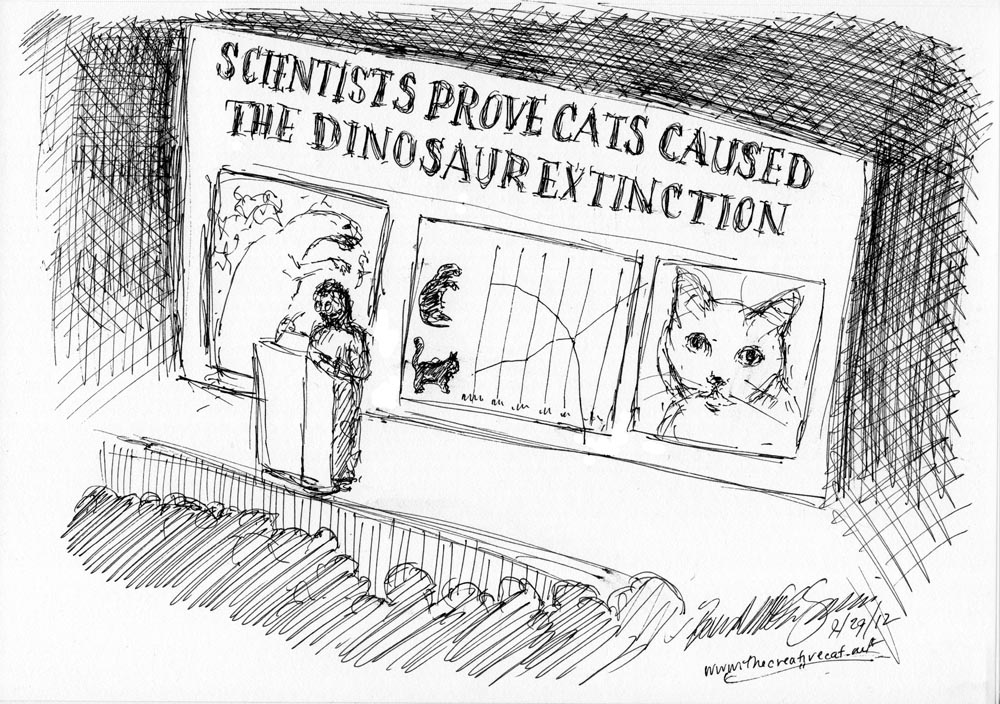
The late paleontologist Stephen J. Gould believed that human evolution was completely a happenstance occurrence. For instance, Gould argued that consciousness would have never evolved if a meteor had not wiped out the dinosaurs, allowing for the rise of mammals.

Interestingly, Simon Conway Morris, a Cambridge academic and highly respected evolution scientist (and a Christian) highlighted by Gould in his work, opposes Gould’s “happenstance” view.

Conway Morris supports the idea of convergence in evolutionary history. Convergence means that there are a limited number of ways to solve a biological problem. The best example of convergence is the eye.

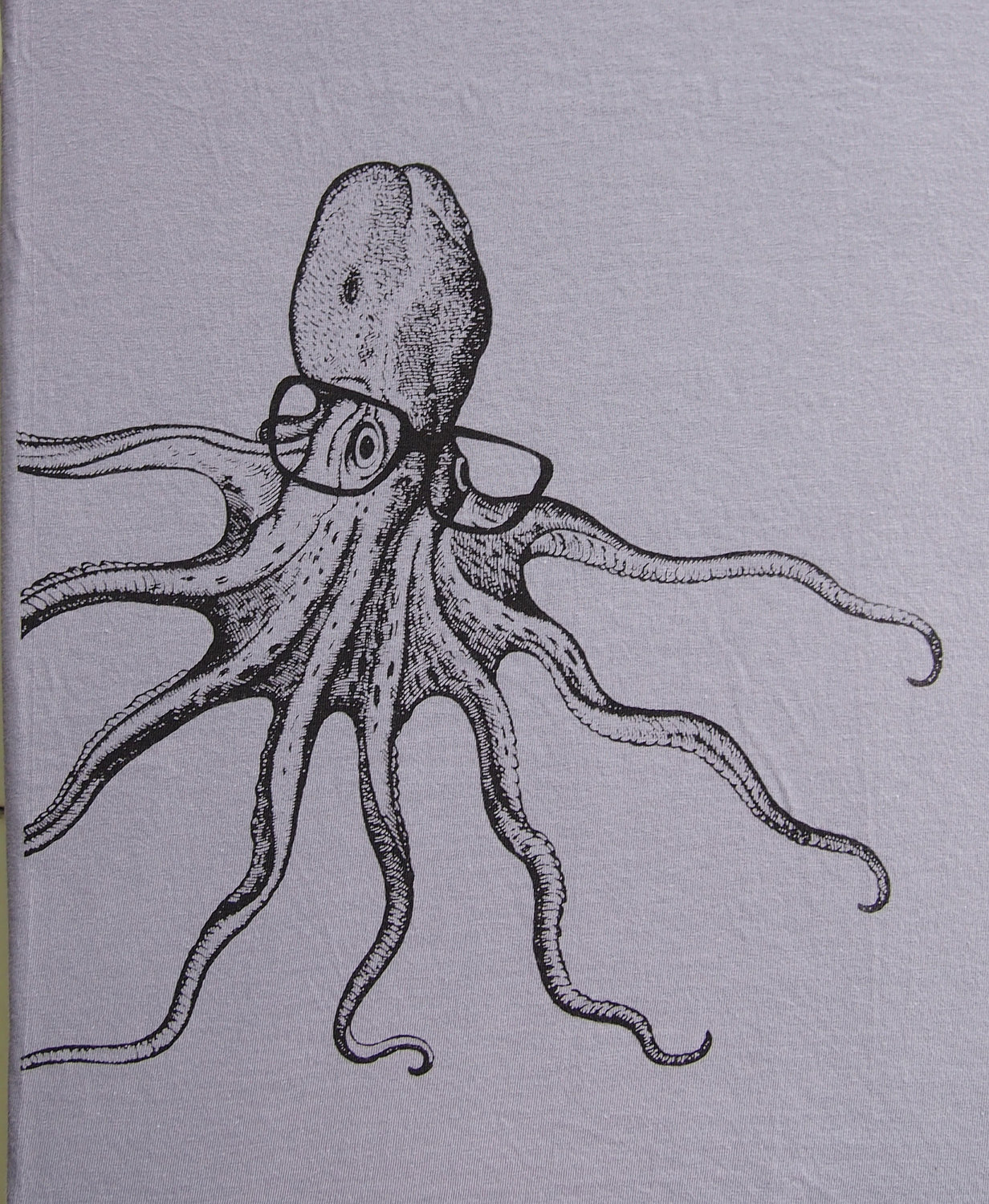
Humans and octopuses do not share a close common ancestor, yet the eyes of humans and octopuses are nearly identical. On two very separate evolutionary paths, the process of evolution solved a problem (the need for vision) in the same way. Throughout evolutionary history, the eye has developed independently at least seven times (Language of Science and Faith, p. 203).

octopus wearing glasses

According to Conway Morris, the playing field of natural history is tilted toward big brains, remarkable eyes, consciousness, language, and complex thought. Conway Morris’ research supports that these traits would inevitably emerge from the evolutionary process:

Contrary to popular belief, evolution does not belittle us. As I argue, something like ourselves is an evolutionary inevitability, and our existence also reaffirms our one-ness with the rest of Creation (p. 204).

So what do we do with Genesis?

Genesis is an ancient story, passed down, and finally written down in its current form during the time of post-exile Israel. The purpose of Genesis is not to give a biological description of how humans came to be. The purpose of Genesis is to say Who did the creating – God – and that humans are part of God’s plan and purpose.

How does the story of Adam and Eve fit into a billions-of-years-old earth and humans originating in Africa hundreds of thousands of years ago? It might surprise you to know that over the years, there have been many interpretations of the Adam and Eve story among Christians – some literal, some theological.

adam-and-eve

A literalist reading of the creation story says that Adam and Eve were specially created and that all humans are descendants of this first couple. There are many problems with a literalist reading of the creation story. Narrative problems include the two conflicting creation stories in Genesis, Cain’s wife and where she came from, and the origin of the people who were out to kill Cain, and the origin of the people populating the city built by Cain. Scientific evidence makes a literal reading even more problematic: recent DNA studies demonstrate that modern humans came from a population of thousands, not just two. In addition, both DNA and fossil evidence demonstrates the interrelatedness of humans and all other animals.

One non-literal interpretation of Genesis is the “everyman” interpretation. This view holds that the Adam and Eve story is really the story of us all. The “fall” wasn’t just about Adam and Eve, it was about all humans’ eventual rejection of God and succumbing to our flawed and sinful natures. A non-literal interpretation posed by Old Testament scholar Peter Enns suggests that Adam is the beginning of Israel, not humanity. Enns’ book The Evolution of Adam explores this idea in depth.

Some Christians (including C.S. Lewis) integrate science with a historical view – humans evolved as the science evidence indicates, and at some point God entered in to a special relationship with humans and made them his image-bearers. It is of course all speculative, but this view fits with either an Adam-and-Eve-are-real-people scenario or an Adam-and-Eve-are symbolic-of humanity scenario.

Seeking to populate this otherwise sterile universe with living creatures, God chose the elegant mechanism of evolution to create microbes, plants, animals of all sorts. Most remarkably, God intentionally chose the same mechanism to give rise to special creatures who would have intelligence, a knowledge of right and wrong, free will, and a desire to seek fellowship with Him (The Language of God, Francis Collins).

Christianity survived the fall of a geo-centric solar system, and Christianity can survive human evolution.

And now….

This:

This is probably my favorite video clip of all time. How can you beat a musical combo of the preeminent modern New Testament scholar, N. T. Wright, world-renown geneticist Francis Collins, and the Beatles?

Please watch….

It’s a funny, beautiful, and truthful ending to this discussion:

N.T. Wright sings “Genesis”

This series is a chapter by chapter discussion of The Language of Science and Faith by Karl W. Giberson and Francis S. Collins, with my commentary and my observations.

****************
I believe that the heavens declare the glory of God.
I believe that day after day the cosmos pours forth speech and night after night the cosmos reveals knowledge.
I trust that the evidence and knowledge that is revealed is true because the Creator of the cosmos is Truth.

What is the Fine-Tuning of the Universe?

Apparently the universe knew we were coming.

sherlock_holmes

Freeman Dyson, one of the greatest physicists of the twentieth century, said this about the physical laws of the universe:

The more I examine the universe, and the details of its architecture, the more evidence I find that the Universe in some sense must have known we were coming (The Language of Science and Faith, p. 195).

The physical laws of the universe appear to be designed precisely to support life. In addition, the beginning of it all – the Big Bang – appears to have transpired precisely in a way that would result in life.

Nobody debates this fact – the universe is finely tuned to support the appearance and the development of life.

What is the “fine tuning” of the universe?

There are a myriad of constants in our universe. These constants are numerical values that always hold true – for example, the speed of light.    speed limit of light

There are also forces in nature: the strong nuclear force, the weak nuclear force, the electromagnetic force, and the most familiar of all, gravitational force.

If any one these myriad factors – the constants or the forces – differed even slightly from their actual values, life in the universe would be impossible.

Fine Tuning – Three Examples

carbon  The most important building block of life is the element carbon. Carbon, present in all living things and absolutely essential to life, is a highly improbably element.

But before we talk about carbon – the building block of life – we need to first talk about stars.

Most of the heavy elements in the universe were formed in stars through a process called fusion. Fusion happens when two or more atomic nuclei collide at a very high speed to create a new, heavier element. When fusion occurs, energy is released. Fusion is what fuels the stars and makes them shine:

Twinkle Twinkle Little Star 
I know exactly what you are 

 Opaque ball of hot dense gas 
Million times our planet’s mass 
Looking small because you’re far 
I know exactly what you are 

Fusing atoms in your core 
Hydrogen, helium, carbon and more 
With such power you shine far 
Twinkle twinkle little star 

Stars are primarily composed of the lightest element, hydrogen.

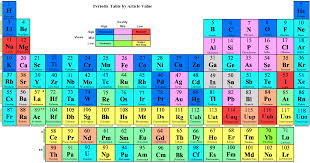
In intensely hot stars, two hydrogen atoms fuse to form helium. Two helium atoms fuse to form lithium, two lithium atoms fuse to form beryllium, and so on as we march across the periodic table.

  periodic table  .

Some fusions are much more improbable – carbon is one example. In order for carbon to form, three helium atoms have to collide and fuse. And if that wasn’t hard enough, energy levels in the colliding atoms must match up in order to form carbon. If three helium atoms happened to collide under normal circumstances, the energy levels would not match up. The helium atoms wouldn’t stick together and the atoms would fly apart before they could actually form an atom of carbon. In the production of carbon, the strong nuclear forces and the electromagnetic forces collaborate in a delicate-just-so dance, working together in a collaborative way that allows an improbable window of opportunity for the helium atoms to stick together and form an atom of carbon.

The slightest change to either the strong or electromagnetic forces alters the relevant energy levels, resulting in greatly reduced production of carbon. And carbon, of course is essential to life, so reducing its production dramatically reduces the probability that the universe will turn out to be habitable (p. 182).

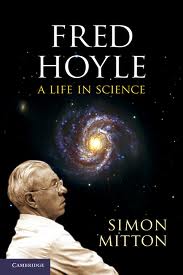
Fred Hoyle, one of the twentieth century’s most renowned scientists, called this phenomenon the carbon resonance.

A commonsense interpretation of the facts suggests that a super-intellect has monkeyed with physics, as well as with chemistry and biology, and there are no blind forces worth speaking of in nature. The numbers one calculates from the facts seem to me so overwhelming as to put this conclusion almost beyond question. (Language of Science and Faith, p.182).

hoyle    (Here’s an interesting side note to the Hoyle quote – Hoyle was an agnostic and in no way wanted to invoke God as an explanation.)

Gravity is the force that attracts you to the surface of the earth (and vice-versa). Gravity is the force that keeps the moon in its path and keeps planets in orbit. Gravity is the force that attracts everything in the universe to each other.

Immediately after the big bang, all matter was randomly distributed – no stars or planets – just individual atoms swirling about in the darkness of space.

Enter gravity.

As matter expanded, gravity began to tug on matter, clumping it into bits, then bigger bits, and bigger. Eventually, matter clumped together as stars and galaxies.

If the force of gravity had been just infinitesimally greater, gravity would have pulled everything back together again, crashing in on itself.   If the force of gravity had been just infinitesimally smaller, matter would have been scattered throughout the universe so loosely that stars would have never formed. Without stable stars like our sun, there can be no habitable planets capable of supporting life.

Paperclip-300x200  Just how exact must the force of gravity be in order to have the universe we have? A paper clip weighs one gram. If gravity was changed so that you weighed one-billionth of a gram less or one-billionth of a gram more than you do now, our universe would have no stars, galaxies, or planets.

None.

No planets, no life.

Goldilocks and the Big Bang. Just after the bang of the big bang, things proceeded in a way that would pave the way for life. For example, if the rate of expansion had been greater, matter would have been so diffuse (spread out) that gravity would not have been strong enough to gather matter together into stars and galaxies. If the rate of expansion had been any slower, gravity would have pulled everything back into a black hole. The expansion rate was “just right” – just like Goldilock’s porridge – not too fast, not too slow.

goldilocksCan We Explain Fine-Tuning Without God?

Because humans exist, the laws of nature are obviously conducive to life. Otherwise, no one would be around to notice.

Right?

This is typically the rationale given by those in the “no God” camp. But is it a satisfying explanation?

Here’s an analogy given by philosopher John Leslie (Language of Science and Faith, p. 187): Suppose you are to be executed by firing squad. There you stand, blindfolded, and all of the guns fire. Every shooter misses, and you survive.

What do you think about your situation?

Do you think: Well of course all of the shots missed. Otherwise, I wouldn’t be here to notice that I am still alive.

Or do you suspect that something’s up? Something went on behind the scenes? A plot to save you, maybe? Why might such an unlikely event occur?

Our universe appears to have something that went on “behind the scenes”. Intellectual curiosity should lead us to at least consider explanations as to why so many unlikely events converged at the instant of the big bang.

Inflation is another God-free explanation for the apparent fine-tuning of the universe, but this theory simply pushes the fine tuning back a step, it doesn’t eliminate it.

Finally, there is the multiverse explanation. This explanation says that there are an infinite number of universes with infinite combinations of conditions and this is the one we happen to live in. There is not wide-spread support for this idea. Interestingly, Stephen Hawking has said that the multiverse idea is really the only way around the apparent fine tuning of the universe.

Proof of God?

Obviously we can’t prove God, but the fine-tuning of the universe definitely points to a Designer/Creator.  Giberson and Collins (p.190) enthusiastically endorse the idea that the universe is intelligently designed (not to be confused with the “Intelligent Design theory” that opposes evolution). The numerous forces, conditions, and constants that must be “just so” provide a compelling argument that a Creator brought matter into existence, governed by finely-tuned natural laws, resulting in a universe where life could develop and thrive.

Modern scientific understanding of physical laws and constants were not what the psalmist had in mind when he wrote:

Creation is maintained by your rulings, since all things are your servants (119:89-91 JB),

nor was Paul speaking as a physicist when he described the Creator-Christ as the one who holds all creation together (Colossians 1:17).

Science can define, observe, describe and articulate natural laws; this does not diminish God as the author and sustainer of those laws.

This series is a chapter by chapter discussion of The Language of Science and Faith by Karl W. Giberson and Francis S. Collins, with my commentary and my observations.

****************
I believe that the heavens declare the glory of God.
I believe that day after day the cosmos pours forth speech and night after night the cosmos reveals knowledge.
I trust that the evidence and knowledge that is revealed is true because the Creator of the cosmos is Truth.

Why is Darwin’s Theory So Controversial?

Why is Darwin’s Theory So Controversial?

Elizabeth Gilbert, bestselling author of Eat, Pray, Love recently published a new novel – The Signature of All Things. The book is fictional, but the historical setting is not. The book follows a nineteelizabeth-gilbert_72140_600x450enth century female botanist, Alma Whittaker.  Through her own observation, collection, and study, Alma, like many natural scientists of her day, came to understand that life on earth had changed drastically – evolved – over time.

Here’s the catch – the fictional Alma (and her non-fictional counterparts upon whom she was modeled) – lived and worked before Darwin.

Evolution Before Darwin

Prior to Darwin’s Origin of Species in 1859, the idea of the development and evolution of living things over time was widely discussed – and accepted – by scientists and natural philosophers. What Darwin did was to articulate the process (natural section) by which these changes occurred.

The vast amounts of time needed for evolution was not initially a sticking point for Christians. The idea of a very old earth was widely accepted before Darwin, even among conservative Christians. Advances in geologic science and a rapidly growing roster of fossils pointed to an ancient earth – and nobody was really upset about it. For most Christians, an old earth did not contradict the Genesis creation story.

An old earth was usually reconciled with a literal reading of Genesis in one of two ways: the day-age theory or the gap theory. Day-age theory said that the “days” of Genesis were not 24-hour days, but instead were epochs of geological time. Gap theory said that there was a great gap of time between God’s creation of the heavens and the earth and the creation week found in Genesis. In light of scientific data, many nineteenth-century Christians adjusted their reading of Genesis without widespread upset.

Reaction to Darwin – Then and Now

Initially, Christian opposition to evolution was focused in two areas.

The non-directed (random) nature of the evolutionary process was seen as purposeless and without meaning. Actually, the thought of animals and plants evolving was far less offensive to most Christians than the thought of a “meaningless” process.

The second point of opposition lay in the biblical scholarship battles of the day. Because religious modernists (the “liberals”) tended to be captivated by new science discoveries, they also tended to accept evolution. The very fact that liberals tended to accept evolution was reason enough for many Christians to deny it. Even so, by the end of the nineteenth century the evolution of species (except humans) was accepted by many Christians, including several conservative theologians.

Practically no one was arguing for a very young earth except the Seventh-Day Adventists, whose founder claimed a vision revealed to her that Noah’s flood was responsible for fossils.

Darwin, Evolution, and Twentieth Century Christians

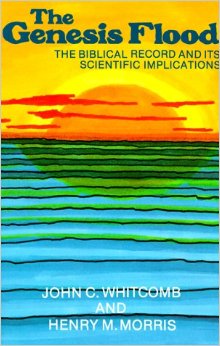
George MacCready Price, a self-taught geologist and a Seventh-Day Adventist, expanded the flood explanation in a series of genesis flood coverbooks in the early part of the twentieth century. In 1961, the flood/fossil idea was updated and was published in what would become the centerpiece book of the young-earth-creation-science movement: The Genesis Flood. Because of Sputnik (1959) and the subsequent push for improved science education in American schools, evolution as a topic began to appear in earnest in science text books.

headline sputnik

In response, The Genesis Flood school of thought caught fire and took off.

It soon became a matter of Christian orthodoxy to deny evolution and an old earth.

Groups like Answers in Genesis and The Institute for Creation Research have advocated “teaching the alternative” or  “teaching the controversy” (young earth/special creation/fossils from the flood VS evolution) in schools.

teach_the_controversy_by_ex_leper-d2xgnki

What Are the Challenges to Evolution?

Some questions about evolution were problems at one point, but have now been fully resolved. Not long after Darwin, physicists argued that the earth was only about 100 million years old, not nearly enough time for evolution to have produced the current variation in living things. It was assumed at that time that the earth began in a molten state and had been cooling ever since. Analysis of the rate of cooling from the heat remaining in the ground (volcanoes, geysers) revealed that the earth could not possibly be billions of years old (Language of Science and Faith, p. 162). Not long afterwards, radiation was discovered. Radiation has been releasing heat into the earth since the earth began, countering the cooling process. Radioactive elements are also a very reliable natural clock – because we know the amount of time needed for one element to decay into another, we can determine the age of rocks.

Long-resolved challenges to evolution like this are now only problems for those who are not current with scientific literature or who do not respect the literature.

Some questions about evolution are not really problems at all, but are premised on misunderstandings of science. A common argument against evolution is that evolutionary theory breaks the second law of thermodynamics. The second law states that everything becomes disordered over time. We see examples in everyday life – cars don’t get newer, they rust and corrode. Fruit doesn’t get fresher, it decays. Evolution seems to say just the opposite – simple, primitive cells evolved into the brilliant complexities of modern organisms.

Here’s the important part – the part that is misunderstood: the second law says that disorder increases in an isolated system. Almost every system in nature has input from the outside. Input from outside a system can produce order.

Here’s a familiar example: green plants and the process of photosynthesis. With energy input from the sun, green plants turn carbon dioxide and water into sugars. As long as the green plant has energy input from the sun, sugars will be constructed – order is increased.

Go to any elementary school science fair and I promise that right next to the kid who investigated “playing rock music vs. classical music to potted plants” you’ll find a junior scientist “investigating” what happens when you grow plants under a box in the dark. Take away the outside input, and the plant starts to decay – it becomes “disordered”. science-fair-projects-for-kids-growing-plants

Interesting to note that as the sun produces the energy that is used by plants to become more ordered, the sun itself is becoming more disordered.

As evolution unfolds on earth the sun becomes increasingly disordered and the total order of the solar system and the universe is still decreasing (Language of Science and Faith, p. 167).

Biological systems (living things) are not isolated systems, so the second law does not apply to them.

Some questions about evolution are unanswered…so far. Probably the most concerning unanswered question is about the origin of life itself. Evolution theory explains the development of life on earth. Evolution theory says nothing about the origin of life – that is a separate question. Scientists have a pretty good idea about when life appeared on earth (about four billion years ago) but no agreement on the how.

But – just because we don’t have a science explanation for how life emerged today does not mean that we won’t have one tomorrow. It is tempting to put God in our gap of knowledge: since we don’t know how life began on earth, it must have been a special miraculous intervention by God. Then what happens if tomorrow’s headlines announce that scientists have discovered how life began? Is all lost for believers in God?

Hardly.

If (or when) the origins of life are found, we will not have disproved God; we will have discovered the mechanism by which God brought life about on earth.

…God’s original and elegant plan for the universe may well have included the potential for life to arise without necessarily requiring later “supernatural” engineering to jumpstart the process. In this view, God’s sustaining creative presence undergirds all of life’s history from the beginning to the present (Language of Science and Faith, p.175).

Side note: Last week, Dr. Giberson, one of the co-authors of The Language of Science and Faith, debated a young earth creationist in an event sponsored by the Center for Creation Studies.

It’s lengthy, but very interesting. Here’s the linkgiberson debate

Dr. Giberson is a very patient man!

This series is a chapter by chapter discussion of The Language of Science and Faith by Karl W. Giberson and Francis S. Collins, with my commentary and my observations.

****************
I believe that the heavens declare the glory of God.
I believe that day after day the cosmos pours forth speech and night after night the cosmos reveals knowledge.
I trust that the evidence and knowledge that is revealed is true because the Creator of the cosmos is Truth.

Science and the Existence of God

Do you believe in God?

Have you ever been put in the spotlight and asked just that question?

640px-Lisa_on_the_witness_stand

You are on the spot now – What say you?

With biting humor, Bill Maher looked at modern belief in God in his 2008 documentary, Religulous. It is cleverly made, but quite often uncomfortable to watch. Why would any educated, intelligent person in the twenty-first century believe in God any more than they would believe in Santa Claus, Zeus, or a Flying Spaghetti Monster?

Can a Reasonable, Rational, Science-believing Person Believe in God?

 Common Arguments for the Existence of God

  • First cause argument: why is there something rather than nothing? Everything in existence was “caused” by something or someone. God is the “first cause” of everything and he started the chain of all other causes. This argument actually predates Christianity – it was proposed by Aristotle in the fourth century B.C.
  • Design argument: the universe displays intricate and complex design. Just as a complex machine or a fantastic example of architecture points to the existence of its designer, the universe also points to a designer (God).
  • If you can imagine it, then it is so: if it is possible for God to exist, then he exists. (I know- doesn’t make a lot of sense. This isn’t a very popular argument).
  • Love is real: and so is morality, beauty, and loyalty. The non-physical aspects of life cannot be completely explained in a purely materialistic way. There is a reality (God) that is not material or physical.
  • Logic argument: some things are always true and this truth does not depend on human minds. This argument says that things like logic, science, and ethics do not make sense in the absence of God.

The sometimes uncomfortable truth is this: we cannot absolutely prove God’s existence. None of these arguments settles the case once and for all. Some of the arguments are flawed.

All the same, reasons for belief in God can be meaningfully discussed and taken as evidence that he exists.

The Problem of Evil

How can a good, loving, and all-powerful God allow evil and suffering in the world?

 Of all the challenges to faith, few are greater and have caused more believers to abandon their faith than the problem of evil (The Language of Science and Faith, p. 127).

Actually, the problem of evil is a conundrum for both believers and nonbelievers.

For nonbelievers, the problem is truth. If truth is not absolute, then there is no absolute morality. “Right and wrong” are simply artifacts of culture and human social development. In the absence of an absolute morality, no one can complain about the unfairness of any kind of suffering or injustice….it just is what it is.

For believers, the problem is inconsistency. Believers must reconcile the apparent conflict between a loving, all powerful God in charge of a world filled with Holocausts, human trafficking, terrorists, disease, and natural disasters.

The Problem of Human Evil

Humans are free-willed beings. From a Christian perspective, free will is a gift from God that gives meaning to life. We were not created as programmed robots that act in a predetermined way. We can choose to accept the love of God – or not. Free will also means that humans are a primary source of evil in the world. Humans are free to choose murder, theft, torture, trafficking, and lies.

Only an actual choice – real freedom – can give us a genuine relationship with God. But with real freedom, evil is always an option.

The Problem of Evil in Nature
plague

Yersinia pestis

Disasters  in the natural world cause untold suffering. Polio cripples and malaria kills. People die in tornadoes, hurricanes, earthquakes, and floods.

And on a daily basis, vipers have poison, bees sting, mosquitoes bite, and cats torture their prey before they kill it. Predator and prey in the animal kingdom, where death and suffering are ironically the way of life.

Some Christians do back-bends with their theology in order to reconcile the violence of nature with a good Creator God and the perfection of Eden. A popular explanation is that no animals were carnivores prior to the sins of Adam and Eve in the garden.

We have to suppose that every animal on the planet had its way of life dramatically transformed by the curse. Sharp teeth and poison glands – and the genetic code to produce them – had to pop into existence, since animals were now going to start killing each other for the first time (Language of Science and Faith, p. 131).

vegitarian lion

Quite simply, there is just no evidence in the fossil record of carnivore-style teeth suddenly appearing – and teeth fossilize very well. Additionally, natural laws such as gravity, force, and tectonic plate movement must be suspended in order to support the supposition of a perfect, nonviolent world: no animal deaths from falls, no squishing an insect with a carelessly placed hoof, no earthquakes or volcanoes.

Overwhelmingly, it is clear that death, suffering, and natural disasters were commonplace billions of years before humans appeared.

 The Problem of Evil and Intelligent Design

Intelligent Design (ID) is an explanation of origins that is touted as an alternative to evolution. The Intelligent Design argument says that the exquisite and complex features of creation point to a Designer (understood to be God) who individually designed each component of the natural world. Intelligent Design highlights helpful components of nature such as the human eye, the human blood clotting mechanism, and interesting things like the “cute” little motorboat-like flagellum of bacteria (p. 132).

Intelligent Design proponents, however, do not talk about the more sinister “designs” in nature: the incredibly well-designed and successful AIDS virus or the really efficient bacteria that killed millions with plague. And then there is the especially charming species of wasp that lays its eggs in a caterpillar. When they hatch, the baby wasps nourish themselves by eating the internal organs of their hosts in the order that ensures their hosts live as long as possible (Language of Science and Faith, p.130).

Some have suggested that Satan is responsible for the creation of the distasteful things in nature, but this is elevating Satan to the level of creator (p. 133).

I can’t go there.

How Might Evolution Help Faith?

By faith we believe that all creative power comes from God, but this power can be wielded by nature to form, build, shape, and create. Tides, rivers, wind, even gravity are constantly forming and reforming the earth.

In the most minute sphere of the physical world – the subatomic level – things really get interesting. Identical electrons will “choose” to behave in different ways. This behavior is random and is not predictable.

…many processes in nature exhibit a genuine unpredictability that looks, for all the world, like freedom (p. 134).

Analogous to the freedom given by God to humans is the freedom given by God to all creation. God does not micromanage human behavior, and the result is that we humans abuse our freedom and bad things happen. Bad choices are the result of autonomy. Likewise, God does not micromanage nature. In its autonomy, nature will produce some bad designs (from a human perspective).

Humans and nature have been granted freedom by their Creator – neither are programmed robotic creations.

So why doesn’t God intervene? No one can explain why God doesn’t stop great evils like the Holocaust. No one can resolve the problem of when and why God chooses to intervene in human history or in nature.

It does help, however, to realize that genuine freedom – the very real freedom that allows us to love God – has to allow evil.

If God constantly intervened and blocked the consequences of the moral choices of humans every time they lead to evil, moral responsibility would disappear (p.140). We would be free to lash out, harm, and even murder those who anger us, confident that God would swoop in and undo the results of our wrath.

If God constantly intervened and blocked the consequences of natural laws, our world would be unpredictable and science wouldn’t work.

Moral Laws and God

Just as some use evil to argue against the existence of God, the unfairness of evil can be interpreted as support for God’s existence. Whenever we complain about the unfairness of a situation like cheating, bigotry, or third world debt, we are appealing to some sort of higher standard – the way things “should be”. If we are nothing more than an assemblage of chemicals, why should it matter?  One molecule owes nothing to other molecules. Our moral sense of right and wrong transcends our material selves.

It has been suggested that our moral selves evolved as our big brains evolved. It is true that caring and helpfulness and other positive traits are beneficial and could have evolved to aid human survival. It is entirely possible that God could have used natural processes to produce moral standards in humans, but there is currently no compelling theory for this (Language of Science and Faith, p. 143).

The prevalence and universality of moral standards is completely consistent with the existence of God. 

If we accept the reality of such moral laws, then we must ask about their origins. God is a reasonable conclusion to such exploration (Language of Science and Faith, p. 144).

Evolution Helps Faith – Really

The subject of evolution makes a lot of Christians really nervous. Many smart, thoughtful believers consciously avoid even investigating evolution for fear that science is corrosive to faith.

In addressing the age-old question of “how can a good God exist when there is so much evil in the world”, science is a positive. Evil, both human and natural, are the results of the freedom in creation. God is not the cause of evil.

Our universe appears to have a beginning. It appears to be fine-tuned for life. Our universe appears to have a place for love and purpose. To deny the existence of God is to say that the universe is not really as it appears – it’s all an illusion.

The fool says in his heart, “There is no God.” Psalm 14:1

This series is a chapter by chapter discussion of The Language of Science and Faith by Karl W. Giberson and Francis S. Collins, with my commentary and my observations.

****************
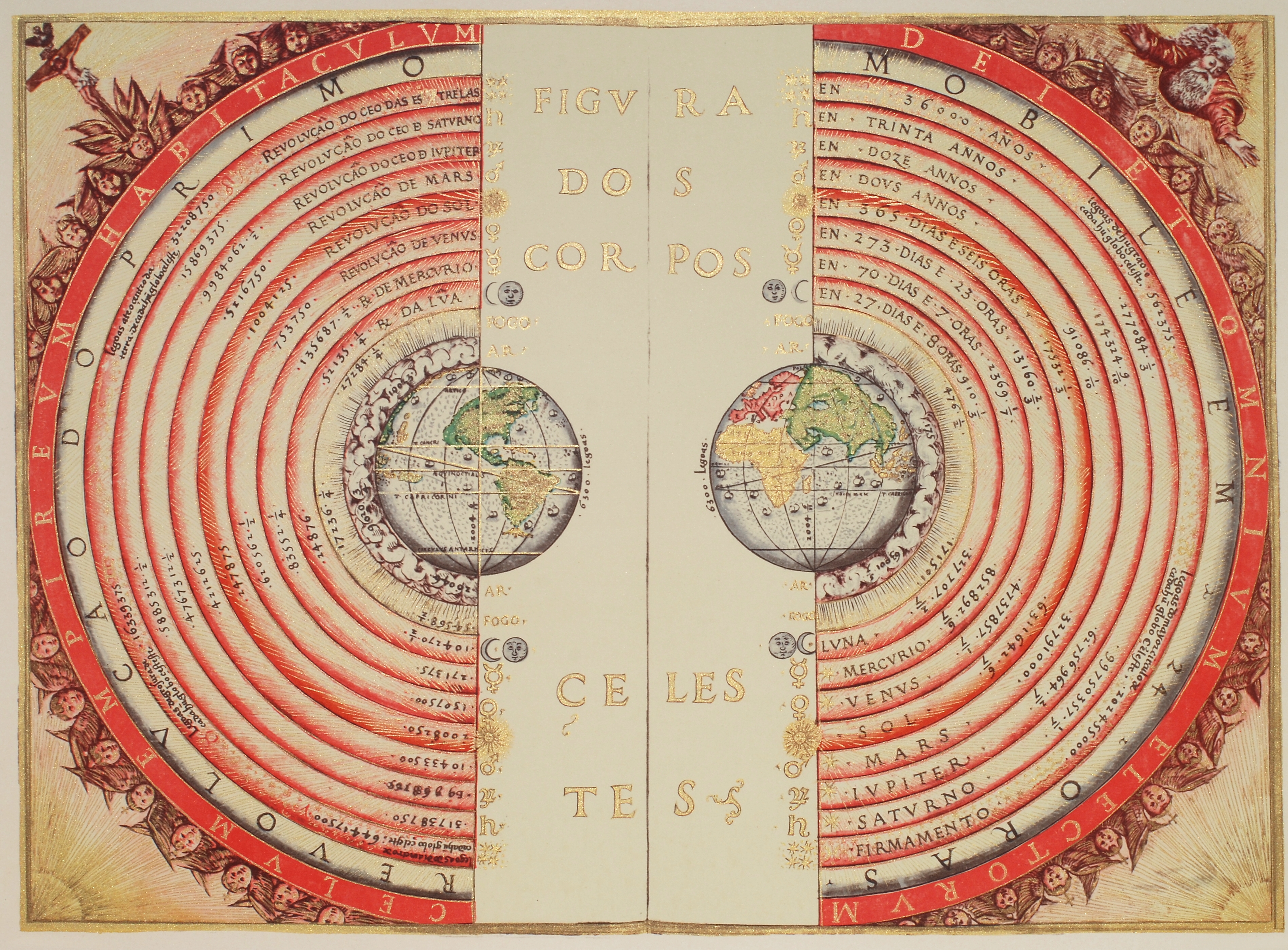
I believe that the heavens declare the glory of God.
I believe that day after day the cosmos pours forth speech and night after night the cosmos reveals knowledge.
I trust that the evidence and knowledge that is revealed is true because the Creator of the cosmos is Truth.