The Ark Was Round?

It must have been a sight.

London,1872. Tucked away in the depths of the British Museum, curator George Smith suddenly jumps up from his work and runs around the room, hooping and hollering. GeorgeSmith
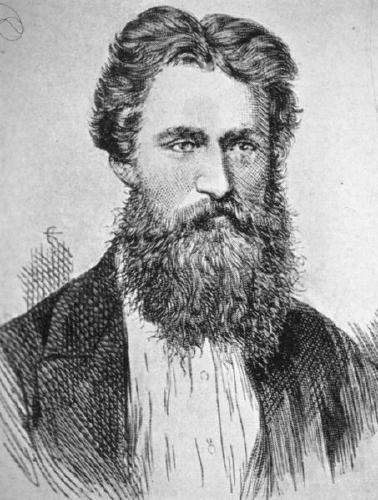
And – to the astonishment of his colleagues – proceeds to strip down to his skivvies.

What would provoke such a display?

George Smith had been translating an ancient Assyrian tablet (7th century BC) when he came upon a story about a devastating flood: forewarned by the gods, a man built a big boat and filled it with animals and his family, and later sent out a dove and raven to check for dry land. All this in a story that far predated the book of Genesis.

Whaaaaat???

The uncanny similarities between the flood story in the more-ancient Epic of Gilgamesh and the Noah story were worrisome to many believers in 1872. There is an even older Mesopotamian flood story (17th century BC), a prequel to Gilgamesh, which also mirrors the Bible story.

The Round Ark

Just a few weeks ago, a 4,000 year-old newly-deciphered cuneiform tablet went on display in the British Museum. ancientarkThe flood story contained in this tablet predates other Mesopotamian stories and the Genesis story.  The boat-building and animal-gathering instructions are more technical and detailed than in subsequent flood stories.  The biggest media splash, however, was the description of the boat – giant, made of rope, and round.
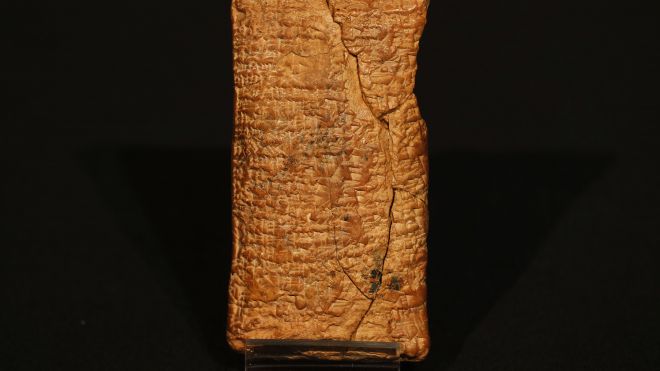
The boat described is an oversized coracle, used in ancient Iraq as water taxis.coracle_india

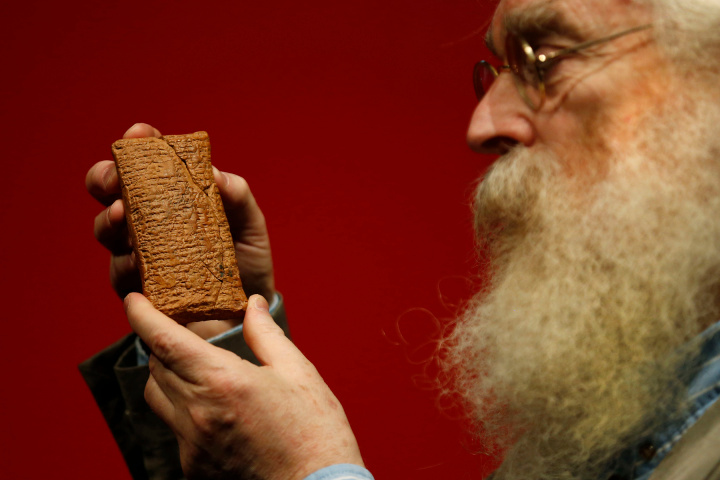
The (fully clothed) museum translator, Irving Finkel, was delighted. Irving Finkel
Uneasy

Discoveries of flood stories more ancient than Genesis make many Christians uneasy for several reasons.

  • If your theology requires a literal world-wide flood, you might be uneasy.
  • If your theology requires that the Noah story be the original flood story, you might be uneasy.
  • If your biblical interpretation does not make room for culture and context, you might be uneasy.

The Science

There is a line of thinking specific to many in the young-earth camp that attributes earth’s complex geologic history to a global flood as described in Genesis. From continental drift, to the Grand Canyon, to fossil layers, to the demise of the dinosaurs – a literal, global flood has been credited as the cause. dino ark
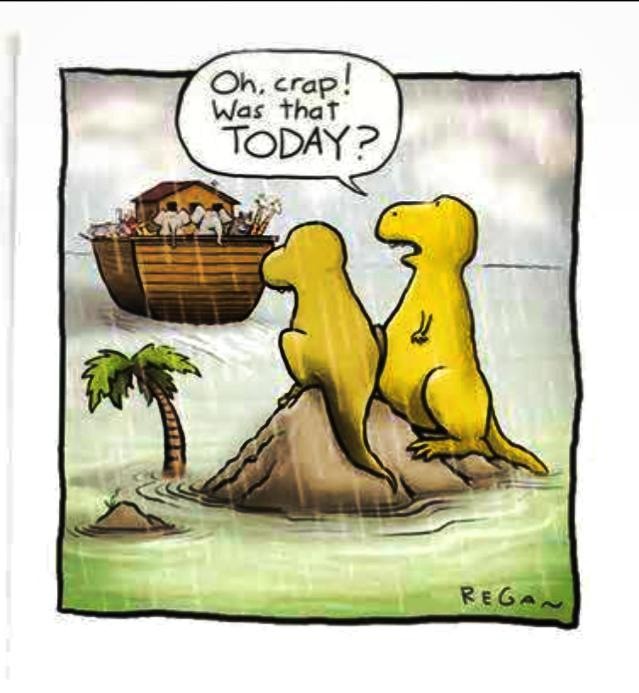
Can we find geological evidence to support such a catastrophic event?

Salt deposits. There are many massive salt beds on earth, some thousands of feet thick. We know how salt beds form – we can observe actively growing salt beds such as those in Utah. Salt beds form when salty water evaporates. Global flood proponents argue that the massive salt beds found throughout the world are the result of waters evaporating from “The Flood”. The problem with this explanation is that the salt beds are covered with thousands of feet of sediment, also said to be left by The Flood. Water from The Flood could not have evaporated enough to produce the vast amounts of salt and still be massive enough to produce the thousands of feet of sediment on top of the salt.

Grand Canyon. Every year, Answers in Genesis guides rafting tours of the Grand Canyon. According to the trip website, the guides

…give the biblical creation perspective on the formation of Grand Canyon, which stands as a testimony of the global Flood of Noah’s day.

I teach a “how to teach science” course to elementary education majors. In our soil lesson, we fill a glass jar – half soil, half water – and shake the jar vigorously until it looks like chocolate milk. We let the mixture settle for a few hours and this is what we see: jar soil

The heavier rocks settle out first, followed by finer sand, followed by finer silt, then clay, finest of all.

In geology, this phenomenon is called fining upward. When flood waters recede, we can observe a “fining upward” sequence in the layers of soil that are laid down by the floodwaters – coarse layers at the bottom, getting finer and finer toward the top.

If a single catastrophic flood – a single surge of rushing water – was responsible for carving the Grand Canyon, we would expect to see coarse layers at the bottom of the canyon, with finer and finer layers to the top. But that is not the case.
Deposition in Grand Canyon is a series of alternating layers – fine, coarse, fine, coarse, fine, coarse, and so on. Some of the alternating layers are larger than others. Now, throw multiple layers of limestone (never found in large flood deposits) into the mix, and Flood explanations for the Grand Canyon are in serious trouble.

Fossils. If a global Flood was responsible for the layers of fossils we observe today, what should those layers look like? Waters turbulent enough to rip up and move continents would churn all unfortunate non-ark animals as well as the bodies of previously deceased animals into one big animal-soupy concoction. There would be no orderliness to the fossil record; instead, we’d have the paleontological equivalent of a scoop of rocky road ice cream.

rocky road ice creamBut that is not what fossil layers look like. In very old rocks, we find fossils of trilobites. In later rock beds we find dinosaurs. Later still, we find mammoths and other mammals…and humans. Flowering plants are found in newer rocks, but not in older rocks.

Localized Flooding

Geophysicists William Ryan and Walter Pitman have documented scientific evidence that there was an enormously catastrophic flood in the middle east about 7,500 years ago. There is evidence that as sea levels rose following an ice age, the Mediterranean Sea overflowed and deluged the Black Sea basin. Ryan and Pitman estimate that waters could have rushed through this channel with forces greater than Niagara Falls, with water levels rising six inches per day.

In addition, there are written records of catastrophic floods in Mesopotamia that date back to 2900 BC. These accounts coincide with observable flood deposits in that area.

Whether they were Neolithic farmers 7,500 years ago or Mesopotamians 5,000 years ago, the flood refugees would have thought the world was ending. From their limited perspective, the whole world was under water.

It is reasonable that ancient Babylonians would pass down stories of a catastrophic flood and that these stories would find their way into the literature of the people.

It is also reasonable that their neighbors, the Israelites, would have this story.

Where the Israelites depart from their near eastern neighbors is theology.

The Theology

To our twenty-first century minds, it’s hard to fathom not being able to predict or even explain natural events like hurricanes, earthquakes, and floods.

Ancient people told stories in an attempt to understand.

The flood stories of the near east (including Genesis) have many shared elements: building boats, collecting animals, judgment, destruction, starting over.

But that’s where the similarities end.

The gods in the Atrahasis and Gilgamesh Epics were angry and revengeful. Humans were created to be slave labor for the gods. The humans rebelled and made so much noise it kept the gods awake.

The God of Israel is just. He sends the flood because humans chose evil and rebelled against him.

The gods of the Atrahasis and Gilgamesh Epics gleefully wiped out everyone. The gods demanded that humans respect distance and boundaries.

The God of Israel saves, restores, and finally (and this is HUGE) covenants. This God, unlike the gods in those other stories, saves because he wants to relate to, live with, and LOVE people.

To argue about the shape of the boat, the extent of the waters, the uniqueness of the story, dinosaurs on the ark or drowning in the flood, or to twist geology impossibly – ALL of these miss the point:

What this stilted literalism does, in its efforts to take the story seriously, is often to miss the point of the story. This story was a major leap forward in human consciousness, a breakthrough in how people conceived of the divine, another step toward a less violent, more relational understanding of the divine.

It starts like the other flood stories started.

but then goes somewhere different.

Somewhere new.

Somewhere better. (What is the Bible? Part 2: Flood).

Design: The New Playbook

(I couldn't find the original, but you get the idea)

(I couldn’t find the original, but you get the idea)

The cartoon illustration elicited gales of laughter from the audience. The ridiculous creature was half cow/half whale. How could such a poor beast exist? The speaker was the late Duane Gish, arch-creationist debater. The place was Tampa, Florida in 1982 and Gish was in a high-profile debate with Dr. Kenneth Miller (a Christian, a cell biologist and author of Only a Theory and Finding Darwin’s God). Gish had long ridiculed the evolutionary prediction that whales had evolved from land animals. Gish pronounced the cow-whale critter an “udder failure”. But paleontologists from the University of Michigan (unknown to Gish) had discovered evidence that the transition from land to sea probably took place near India and by 1994, three intermediate fossils had been discovered. Today, we have multiple fossil examples of land-sea mammal intermediates.
In the early to mid 1980s, Kenneth Miller debated both of the prominent creationists of the time – Gish and Henry Morris. Dr. Miller recounts that Gish and Morris did not just have a problem with Darwin, they had a problem with all of modern science. The debates demonstrated that Gish and Morris were willing to discount modern physics, geology, and astronomy in order to support a literal reading of Genesis.  That willingness to jettison all of modern science, according to Dr. Miller, would become a real PR problem for the creation science movement in the United States.

A New Playbook

Out of the poor showing by creationist heroes Gish and Morris in the debates and the 1988 US Supreme Court decision that outlawed teaching creationism in public schools, the Intelligent Design movement was born. The ID movement was meant to circumvent the anti-science vibes of the creationism science proponents:

They’ve done so not by changing their ultimate goals, but by writing a brand-new playbook, one that’s lighter and infinitely more flexible. With a wink and a nod to the Bible, they’ve set that heavy book aside and stepped into the ring unencumbered by its literalist baggage. ID, they maintain, is a scientific theory, not a religious conviction, and therefore the age of the earth doesn’t matter (Only a Theory, p. 41).

A Stone and a Watch pocket watch

Before Darwin there was William Paley, an English clergyman whose 1802 work, Natural Theology, posed this familiar scenario:

If a man crossing a field comes upon a stone, the man might assume that the stone had lain there forever. But if a man came across a watch upon the ground, he would not assume the same. The watch, he reasons, must have had a maker. The complexity of the watch implies that its parts were designed and assembled for a purpose – telling time.

Paley’s watch analogy was picked up by the ID movement and expanded upon by Michael Behe, one of the leaders of the movement. Behe reasoned that complex biological systems could not have evolved because of a principle he termed irreducible complexity. This simply means that complex living systems could not have gradually come into being (as in evolution) because the intermediate forms would be missing key parts. And if a system is missing a key part, the whole thing breaks down.

Mousetrap

Behe’s analogy was the mousetrap. In order for a mousetrap to perform its intended function, all component parts of the trap must be present and working. A mousetrap is designed to catch mice.

Take away just one part of the trap, and no mousies will be caught. field mouse

According to Behe, a mousetrap cannot be reduced – it is “irreducibly complex” -it cannot be reduced by even one part and still be functional.

ID Hall of Fame

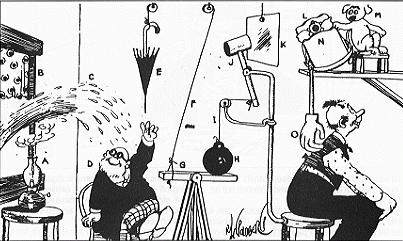
The Blood Clotting Cascade. The cartoonist Rube Goldberg was known for his clever drawings of complicated contraptions. Goldberg would string together an array of unrelated items to perform some sort of mundane task.

rube goldbergBlood clotting in the human body is often compared to a Rube Goldberg machine. Even the tiniest breach in a blood vessel sets off a cascade of events ending in the formation of a blood clot which plugs the leak. The blood clotting pathway consists of multiple steps, each triggering and amplifying subsequent steps. So precise is this clotting pathway that the absence of just one of the components in the cascade has a devastating effect. Individuals (usually males) that lack a factor in the blood clotting cascade will often bleed uncontrollably from even a small wound or bruise – a condition known as hemophilia. Until recent medical advances, missing just one factor in the blood clotting cascade meant hemophiliac boys rarely reached adulthood.

The blood clotting cascade is a favorite of intelligent design advocates:

Consider what this means: If each and every part of the system has to be simultaneously present for blood to clot, then the system could never have been produced by gradual, step-by-step evolution. It is indeed irreducibly complex, and therefore unevolvable (p. 33).

The Flagellum. The blood clotting cascade may be in the ID Hall of Fame, but the flagellum is the darling of the ID movement. Flagella are microscopic whip-like structures powered by a complicated chemical motor. Your body is host to billions of helpful bacteria which zip around your gut driven by their own little outboard motors – the flagella. An array of protein components (maybe as many as thirty, p. 36) must be securely in their places in order for a flagellum to operate properly. flagella bacteria

Remove just one of the components and our cute little bacterial outboard motor sputters to a halt.

Advocates of intelligent design presume

By the logic of irreducible complexity, these components should have no function whatsoever until all thirty are put into place (p.36).

The human eye. The vast information encoded in our DNA. The mammalian ear. According to the intelligent design model, it would be impossible for these things to arise via evolution.

 A Price Too High

For many people of faith, traditional young-earth creationism demands too high an intellectual price. It’s not that they are great admirers of Darwin – they’re not. They actually have a lot more in common with Ken Ham than they would care to admit.

The price of young-earth creationism is too high because

…young-earth creationism requires a full frontal assault on virtually every field of modern science” (Kenneth Miller, Finding Darwin’s God).

Enter intelligent design. Infused with scientific vocabulary and complex concepts, ID has no objection to evidence from physics or geology.

And, important to people of faith, ID assures that an intelligent author is behind it all, putting each protein, molecule, and structure into exact position. Intelligent design offers an alternative to natural processes that are perceived to be blind, cold, and uncaring.

In upcoming posts in this series, I want to examine the idea that scaffolds the intelligent design model: irreducible complexity. Does the concept of irreducible complexity hold true? Is the human body bursting with “mousetraps” that cannot be taken apart?

Does irreducible complexity cast an ominous and final shadow of doubt over the theory of evolution?

I also want to consider philosophical issues of science and faith:

Does natural = cold and uncaring?

Can an evolutionist be a creationist?

What does the theory of evolution say about God? (Spoiler: nothing)

This series is an overview of Kenneth Miller’s Only a Theory with my discussion and commentary. My goal is to examine intelligent design and look at the science behind the antievolution claims of the ID movement.

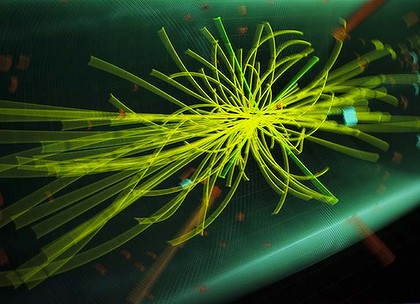
ipad-art-wide-higgs-boson-particle-420x0

I believe that the heavens declare the glory of God.

I believe that day after day the cosmos pours forth speech and night after night the cosmos reveals knowledge.

I trust that the evidence and knowledge that is revealed is true because the Creator of the cosmos is Truth.

Just A Theory

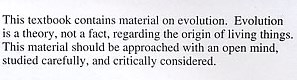
It was a nondescript, address label-sized sticker on the front inside cover of the biology textbook.

textbook sticker image cropped

 At the time, my kids were attending a small (conservative) Christian school. Despite the misuse of the term “theory” on the sticker, I felt the tiniest twinge of optimism that evolution would actually be “studied carefully” and “critically considered” in my kids’ biology class.

Snowball’s chance.

Drawing Battle Lines

The text of the sticker, however, was not original with our private school, or any private school. The sticker was composed by the Cobb County (Georgia) Board of Education and was the centerpiece of a federal court case in 2004. peachIn an effort to align with state science education standards and placate anti-evolutionists, the Cobb County Board created the sticker and placed it in public school science textbooks. In the end, the federal court found that the stickers were a violation of the First Amendment and ordered them removed from the public school textbooks.

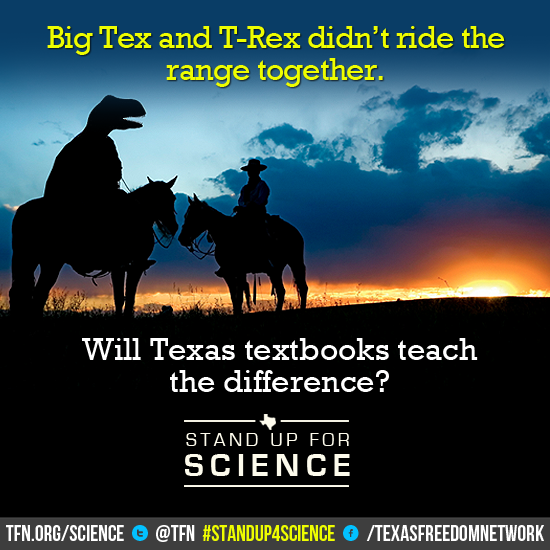
Just a few years prior to this case, the Kansas Board of Education removed all references to evolution in the public school curriculum. The state board was voted out the next election cycle, but four years later an anti-evolution majority was seated. The board again re-wrote the science standards, leaving evolution in but requiring that “evidence against” evolution also be included. big text and t rex didnt ride the range together

School boards in Pennsylvania, Texas, and now Virginia – all have hosted show-downs between science standards, science teachers, and anti-evolution forces.

Kenneth Miller in Only a Theory recounted a conversation with a British scientist who was incredulous at the ongoing battles over evolution in American schools. In Britain (he opined) this would never be! Oxford or Cambridge would simply dispatch a couple of dons who would lay out their degrees and credentials before the local school officials, and then explain the standing evolution had in the modern scientific community. The locals would acquiesce to their expertise, and lay the issue to rest. dont tread on me flag

Americans, Miller explained to his Brit friend, are free thinking rebels at heart. Americans instead would have thanked the experts for their time, but would go on to do just as they pleased. Education in America is a local responsibility.

Blatantly teaching creationism, even as an alternative to evolution, is actually illegal in the United States.  In 1987, the Supreme Court of the United States found that creationism is a religious concept and therefore cannot be a part of public school curriculum.

What now?

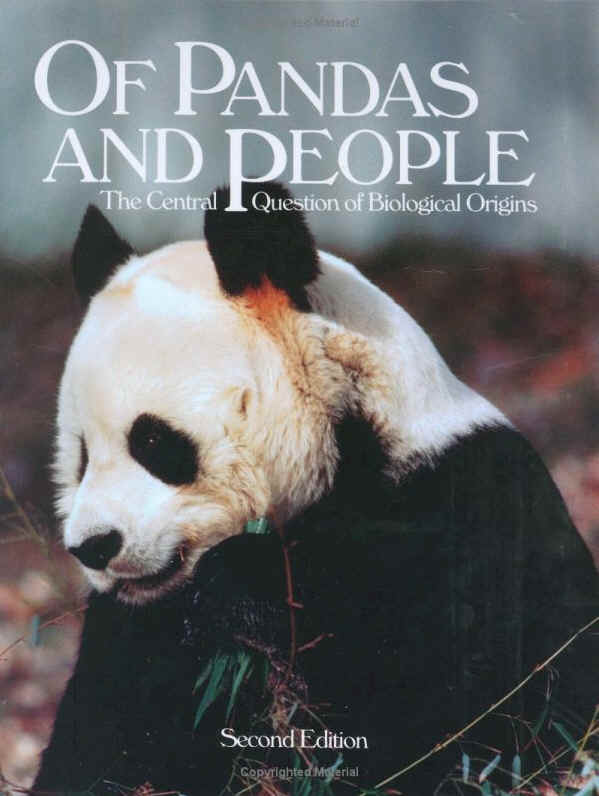
Not long after the Supreme Court ruled that creationism could not be taught in public schools, the anti-evolution forces regrouped and emerged with a new strategy. Creationism evolved (ha!) into a new movement known as “intelligent design” (ID). pandascover1The most popular intelligent design textbook was originally written as a creationist textbook. The text had been repackaged by substituting “intelligent design” for “creationism”.


Intelligent design purposefully avoids any reference to the God of the Bible. Proponents of intelligent design contend

  • purely naturalistic process could not have produced life as we have it on earth
  • the theory of evolution cannot explain the complexity of living things
  • an “intelligent designer” (by which they mean God but won’t say it) was required to specially design life

Because overt creationism cannot be taught, the push at present is to also teach “design” alongside evolution in order to provide “balance” and expose the “weaknesses” in evolution theory.

For example, there is currently legislation before the Virginia state assembly which would require public schools to

assist teachers to find effective ways to present scientific controversies in science classes

…(help) students understand, analyze, critique, and review in an objective manner the scientific strengths and scientific weaknesses of existing scientific theories

just_theories_591

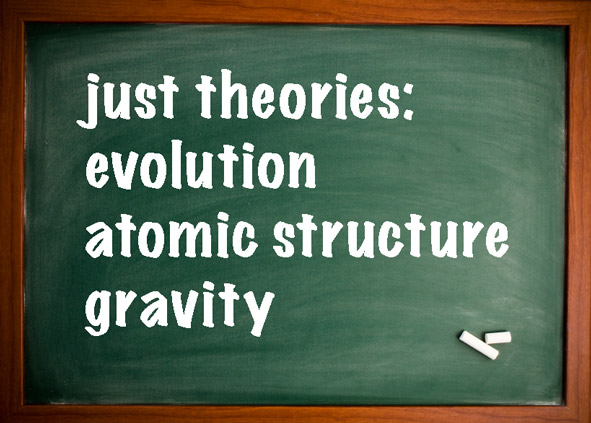
If bills like this become the foundation of science education in Virginia schools, its students (as well as those in several other states moving in similar directions) will learn that:

  • evolution is a deeply flawed theory, unable to explain very much
  • evolution only endures because of coercion and the herd mentality of the scientific community
  • intelligent design (ID) is a better explanation, but has been marginalized because scientists are closed-minded and irrationally committed to naturalism

American students will learn these and many other things that students in Japan, Germany, France, Canada and the rest of the developed world are not learning (Karl Giberson).

A More Science-y Alternative

The intelligent design movement sees itself as the Christian-friendly alternative to the head-in-the-sand young earth creationism of Ken Ham and the Answers in Genesis crowd. Most ID proponents accept an old earth and attempt to support their position with evidence outside of a literal reading of Genesis. The Discovery Institute is the primary think tank for intelligent design.

And, as much as the Discovery Institute would like to be the middle ground between Nye and Ham, their aggressively anti-evolutionary agenda and constant negativity towards science make them allies of Ham, not Nye. As a result, bewildered young people will continue to wander out of the church wondering if they really have to choose between science and their faith. (Karl Giberson, How Creationism Hurts Christian Colleges – And Their Students)

This series is an overview of Kenneth Miller’s Only a Theory, with discussion and my commentary. My goal is to examine intelligent design and look at the science behind the anti-evolution claims of the ID movement.

Dynamo_PNG_Compressed

I believe that the heavens declare the glory of God

I believe that day after day the cosmos pours forth speech and night after night the cosmos reveals knowledge.

I trust that the evidence and knowledge that is revealed is true because the Creator of the cosmos is Truth.

The Ham/Nye Debate

The twitterverse was ON FIRE.

Snippy-snarky comments about Ken Ham or Bill Nye, links to related articles, quotes from the speakers …. I stand amazed in the presence of all those who can listen to a live event, be funny and do research simultaneously.

If you were on the Nye-side, you hashtagged creationdebate. If you were a Ham-fan, you were #ham on nye. It was sciency-theology-former debater-girl nirvana.

And in the middle of it all, this tweet:

Bored of this…can’t we just say God did it and get about feeding the poor?

Well… buzz kill.

 Why should we care?

  • Millennials (brought up in Christian homes) are leaving their faith in droves, and antagonism toward science is a primary reason.
  • Most evangelicals reject scientific evidence about the age of the universe and the development of life on earth.

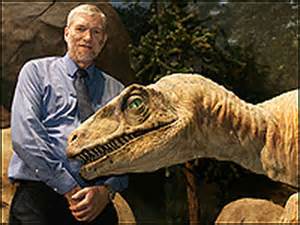
Ken Ham, with the home-field advantage of his Creation Science Museum, ken ham and dino

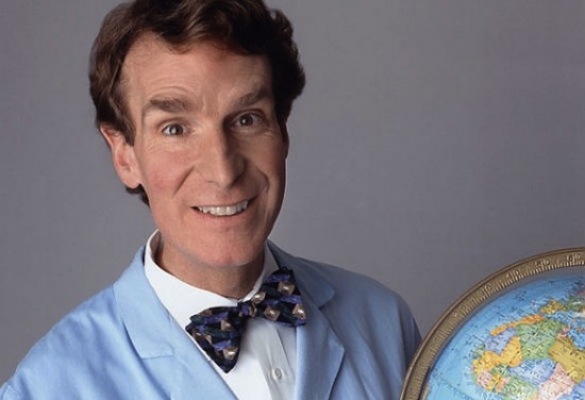
bill-nye    challenged Bill Nye (the Science Guy) to debate this proposal:

“Is creationism a viable model of origins in today’s scientific world?”

 I did not have high hopes for this debate – Nye can be snarky and Ham can be smug. Fortunately, both reined it in. (Ham did deliver his signature line “where you there?” or its counterpart “you weren’t there” innumerable times, but without dipping it too deeply in smirk).

Nye, a science advocate, has been outspoken lately about teaching creationism to children. It is theists, specifically evangelicals, who are drawing the battle lines in state houses and with textbook companies. In order to stop those battles (which Nye wants), the hearts and minds of evangelicals must be won. Bill Nye is Not That Guy.

Ham spoke first and immediately his game plan for the debate was apparent. In slide after slide and point after point – through opening remarks, rebuttal, and Q&A time – belief in young earth creationism was equated with

  • belief in the Bible
  • trust in God
  • the plan of salvation
  • God’s image
  • morality (euthanasia, abortion, marriage)
  • the testimony of Jesus

Ham also equated belief in evolution and an old earth with atheism. In a Freudian slip, Ham used the word “secularist” instead of “evolutionist” during one of his rebuttals.  As an aside, Ham stated that Jesus is the way to salvation not young earth creationism, but overwhelmingly his arguments stated otherwise. (Ham has written previously in his blog that a specific Christian evolutionist theologian was categorically “not evangelical” and doubted that he was a Christian in any sense.

Regardless, in the debate Ham unequivocally defined Christianity by a belief in young earth creationism.

From the center of his 6,000 year-old-universe, Ham drew a line in the sand: Choose science or choose God.

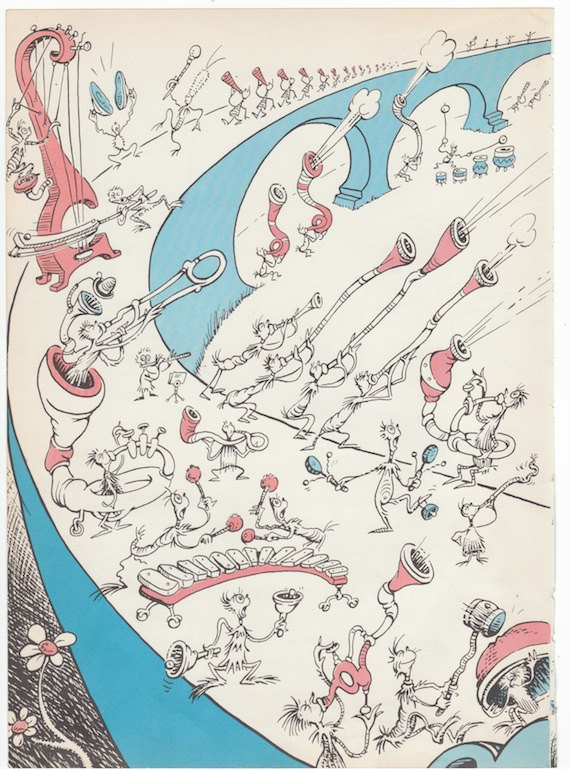
And across the internet, like the residents of Whoville yelling and whooping with big banging noises trying to make themselves heard to the outside world, millions of Christians were shouting “It doesn’t have to be that way!”

whoville noise (2)

“We’re here! We’re here! We’re here!”


Following the debate, Karl Giberson tweeted

Ken Ham’s bizarre approach to creation makes it hard to have a serious conversation about why sensible people still think God is the creator

Yes it does, Dr. Giberson, yes it does.

My favorite quote of the night came during the Q&A time in a question posed to Nye: “Is there room for God in science?” Nye said this:

The head of the National Institutes of Health is a devout Christian, there are billions of people in the world who are devoutly religious, they (science and faith) have to be compatible because those same people embrace science. The exception is you, Mr. Ham.

Props to Nye (an agnostic) for acknowledging premier top-of-their-game  scientists who are also devout Christians.

Props also to Nye for his dogged adherence to the debate topic. Throughout the (almost) three hours Nye prefaced his evidence and his arguments with the debate proposal: is creationism a viable model of origins in today’s modern, scientific era? Nye consistently reminded Ham and the audience that the value of a scientific model is its ability to predict and repeatedly asked Ham what the creationist model is able to predict.

The weakest point in Nye’s debate was his argument against a worldwide flood premised on the inability of an ancient shipwright to build a flood-waters worthy vessel of the magnitude described in Genesis. Again, Nye is not a believer, much less a theologian. There is strong evidence against a world-wide flood and “flood geology” (which Nye presented), but his discourse on ancient shipbuilding confounded his points.

Here are my highlights:

Ham had a three hour window of opportunity to lay out a science-evidenced-based rational for a young earth creationism model (as indicated by the debate topic). Instead, Ham spent the vast majority of his time in his initial presentation, his rebuttals, and the Q&A making the case that evolution and an ancient earth cannot be reconciled with belief in the Bible and the authority of God.

As a result, a lot of time was spent in philosophical discussion, with Ham saying you can’t believe in God and evolution and Nye saying well I know lots of people who do.nuh-uh-vs-yes-huh

Here are the primary points Ham made regarding creationism as a model:

  • Observational science versus historical science (a dichotomy coined by Ham).  The only valid scientific evidence is what we can see – right now. Since “you weren’t there” (Ham’s mantra), no conclusions can be made regarding any geological or biological event in the past. We cannot assume that natural processes we observe today have always been in place.
  • Because “you weren’t there” at the beginning, we must use the Bible timeline for earth history (6,000 years as defined by Ham, based on genealogies).
  • The universe is expanding “to show that God is big”.
  • 7,000 “kinds” of animals left the ark approximately 4,000 years ago. All living species are descended from those 7,000 “kinds”.
  • The world-wide flood caused continental drift

Nye’s primary points as to why creationism is not a viable model: species

  • We have visibly observable ice cores and tree rings demonstrating age far greater than 6,000 years. We have reliable and repeatable rock dating methods that demonstrate ancient age.
  • Considering the billions of animal species alive today, eleven entirely new animal species would have to emerge every single day if Ham’s timeline was accurate.
  • Valid science theories can predict. Evolution theory predicted where certain fossils would be found long before they were actually discovered.
  • There is no evidence to suggest that natural laws have changed.
  • Science is predictable and self-correcting. A single piece of evidence to support creationism as a viable model (for example, atomic clocks resetting) would, in Nye’s words, “change the world”.

I read through my favorited tweets from the debate. If you don’t want to watch the entire thing, I think these three sum it up quite nicely:

@peteenns: Ham comes clean: if Gen 1 is not literally true, the Gospel falls apart. Enter theologian please to help Ham with this. #nyevsham
@BrianZahnd: If it had been Francis Collins talking by himself for two hours I would have watched. #NyeHamDebate
@Arumi_kai: I kept waiting for Neil Degrasse Tyson to burst through the wall like the Kool-Aid guy and set up a third podium. #creationdebate

kool aid

Watch the Ham/Nye debate

I believe that the heavens declare the glory of God.

I believe that day after day the cosmos pours forth speech and night after night the cosmos reveals knowledge.

I trust that the evidence and knowledge that is revealed is true because the Creator of the cosmos is Truth.

Big Tex, T-Rex, and the American Scientific Soul

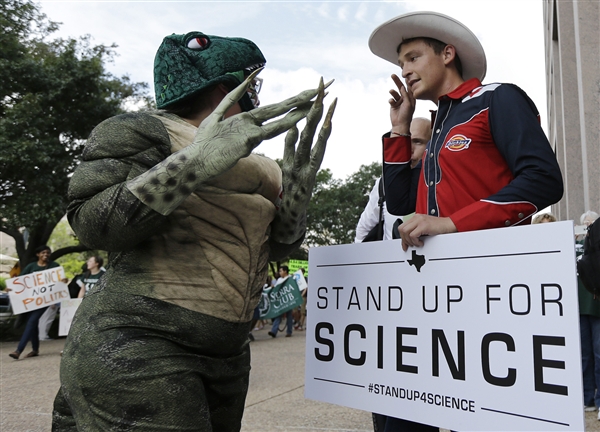
big tex and trex mark in austinMaybe it was in the spirit of “Keep Austin Weird”: Big Tex and a T-Rex on a sunny day last September, marching together across the University of Texas campus.

Their destination (as well as the crowd of supporters following behind) was the State Board of Education’s hearing on the adoption of biology textbooks for Texas public schools.close up of big tex and trex

For decades, Texas has ruled textbook adoptions nationwide. Due to its size and large number of school districts, textbook publishers overwhelmingly sought to please Texas schools. icepocalypse aint texasWith the advent of customizable digital textbooks, this influence may soon decrease. But for now, the (partisan-elected) Texas School Board rules the day.

This past fall, the State Board held hearings to select the biology texts to be in use for the next ten years. Top publishers submitted fourteen books for review. The books were first given to a 28-member review committee selected by the state’s education commissioner.

So reviewers review and make recommendations to the board – makes sense, right?

Here’s the problem: six of the reviewers were known to reject the very basis of modern biology – evolution.

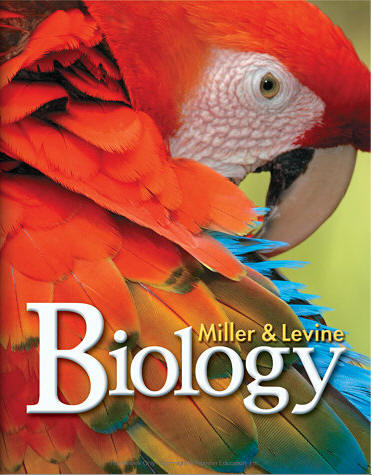
By November, the reviewers had submitted their reports and the State Board of Education voted to accept all fourteen submitted biology textbooks – with one caveat. The board’s approval of Miller and Levine’s Biology (published by Pearson Education and one of the nation’s most highly regarded texts), was contingent on an expert panel evaluating supposed “errors” found by one of the reviewers.

The “errors” in the book were about evolution and were raised by reviewer Ide P. Trotter who, incidentally, is named a “Darwin Skeptic” on the Creation Science Hall of Fame website.

Dr. Ron Wetherington, professor of evolutionary anthropology at Southern Methodist University responded with a point by point rebuttal of the “errors”, soon followed by a 13-page official rebuttal by the Pearson authors, Kenneth R. Miller and Joseph S. Levine. The three member panel subsequently appointed by the State Board to review the claimed “errors” rejected all of them and the Miller and Levine book was adopted without reservation.miller levine text cover

Dr. Kenneth Miller (one of the authors of the disputed biology text) was an expert witness in a similar but more extensive case in Dover, Pennsylvania during the fall of 2005. The issue in the Dover case was an attack on evolution to be sure, but primarily it was an effort to include the concept of “intelligent design” in public school science curriculum.

For the opponents of evolution in the Dover case, evolution was more than just a mistaken scientific idea – evolution was dangerous, destructive, and a threat to the soul of society and culture (Kenneth Miller, preface to Only a Theory).

Using the Dover case as his backdrop, Dr. Miller examines the fight against evolution and the support of intelligent design concepts in his book Only a Theory: Evolution and the Battle for America’s Soul (Viking, 2008). In the preface, Dr. Miller states

There is indeed a soul at risk in America’s “evolution wars”, but it is not the cultural one that (William F.) Buckley sought to save. Rather, it is America’s scientific soul, its deep and long-standing embrace of discovery, exploration, and innovation, that is truly at risk.

The battle grounds are state capitals and courtrooms, but the battle lines are being drawn by Christians.

According to a December 2013 Pew poll, sixty percent of U.S. adults believe that humans have evolved over time.

But break the numbers down by religious groups, and a different trend emerges. Most white evangelical Protestants (64%) and half of black Protestants (50%) believe that humans have existed in their present form since the beginning of time.

This trend is unsettling:

The trajectory is not encouraging, especially as it runs in parallel with a steady increase in the evidence for evolution—evidence now piled so high that not even one evolutionary biologist at any of America’s research universities rejects the theory. Evolution is as widely accepted in biology departments as gravity is in physics departments. (Karl Giberson).

Giberson goes on to ask this important question:

So how is it that 64 percent of “white evangelical Protestants”, an unusually powerful and wealthy demographic, remains so strongly opposed to evolution?

My question is broader: why are evangelicals as a whole opposed to evolution? Why is denying evolution a written or unwritten tenant of most evangelical churches’ statements of faith?

Why should we care?

fraction 3 out of 5Because three out of every five young Christians are disconnecting from church after age 15.

The Barna Group has extensively studied the “millennials” demographic, and they are leaving – in droves. Six reasons for leaving emerged from the Barna research, including “churches come across as antagonistic to science”.

Karl Giberson recounts how science professors at evangelical colleges work, often with little to no support from their university or denomination, to instill in students that faith and science are not incompatible. These professors hope that these young evangelicals will go forth as leaders in their faith communities and persuade their fellow evangelicals that “evolution is not a lie from hell”.

But instead scientifically informed young evangelicals became so alienated from their home churches that they walked away, taking their enlightenment with them.

Introducing a New Series!

This post launches my new blog series. Each posting will be a discussion of Kenneth R. Miller’s Only a Theory, with my comments and analysis. By the way – Kenneth Miller is a Christian. His book Finding Darwin’s God is an excellent examination of evolution and its compatibility with faith and belief in God. I love both of these books, and because Dr. Miller was so recently in the midst of the Texas textbook adoption case, I think you’ll enjoy this series.

I hope you’ll follow along. Please pass the posts along to others!

Science or Faith – Do We Have to Choose?

For the last few months, I have been blogging through The Language of Science and Faith by Karl W. Giberson and Francis S. Collins. Each chapter in the book addresses a FAQ about the Genesis account of creation and scientific evidence regarding the origins of the universe and life on earth.

Each post in the series tackled a chapter question, with my comments and discussion.

What do you think?

Here are links to all of the posts in this series – did you miss any?

Jesus-fish-Truth     Introduction 

joe mendi pic     Do I Have to believe in Evolution?

dinos on ark       Can We Really Know the Earth is Billions of Years Old?

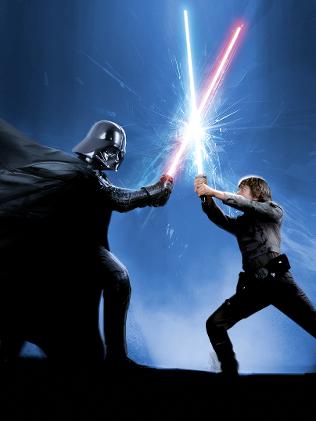
541156-darth-vader-luke-skywalker        How Do We Relate Science and Religion?

Scottish_paper      Can Scientific and Scriptural Truth Be Reconciled?

640px-Lisa_on_the_witness_stand      Science and the Existence of God

teach_the_controversy_by_ex_leper-d2xgnki      Why is Darwin’s Theory So Controversial?

sherlock_holmes      What is the Fine-Tuning of the Universe, and How Does it Serve as a Pointer To God?

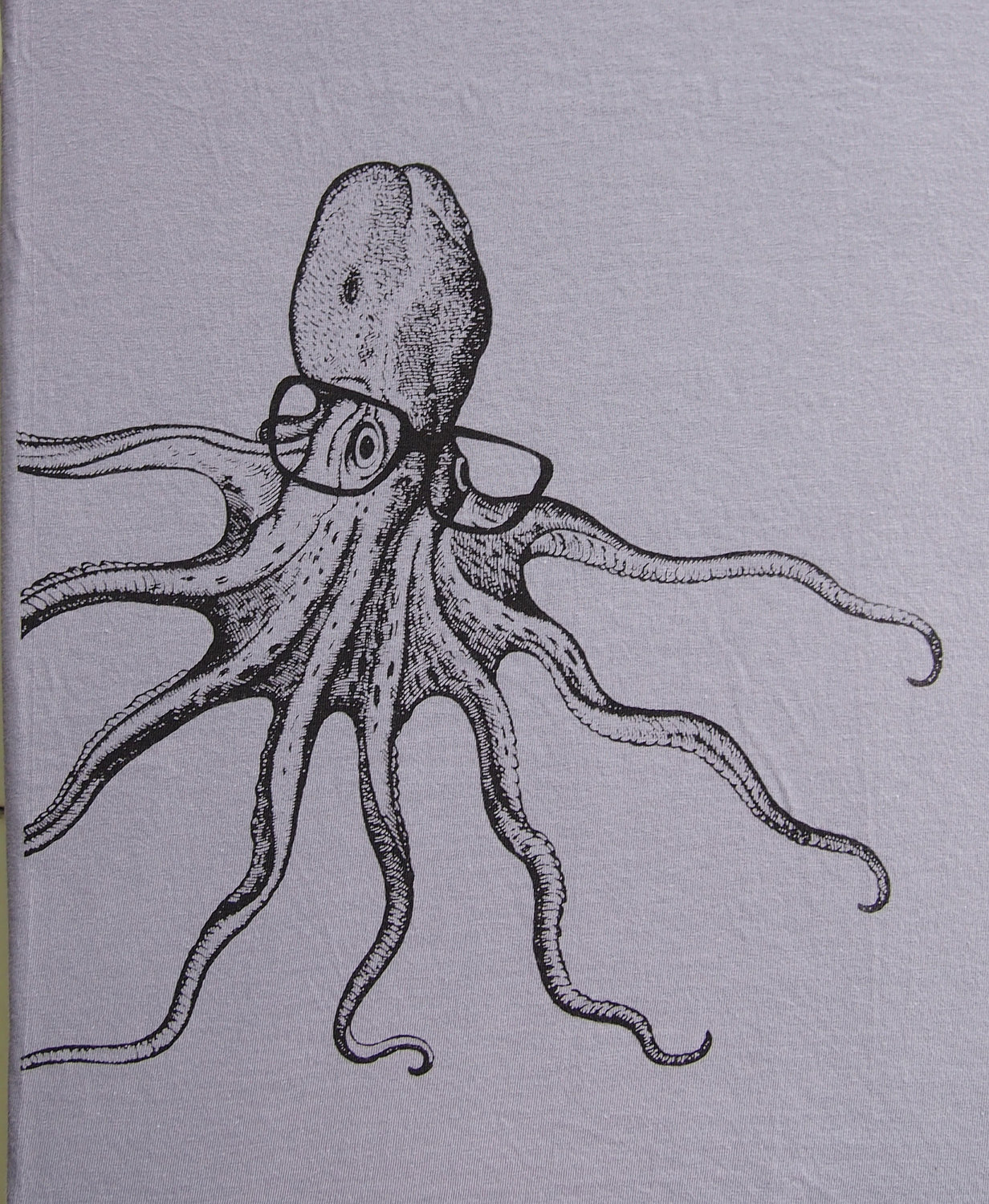
octopus wearing glasses     Evolution and Human Beings

Evolution and Human Beings

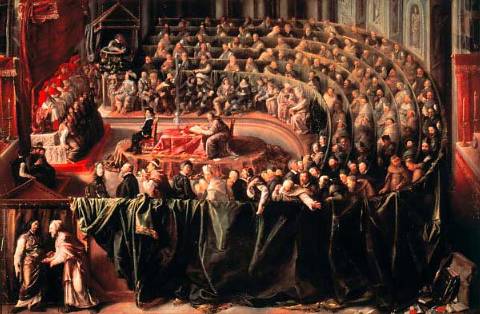
We pronounce, judge, and declare, that you, the said Galileo… have rendered yourself vehemently suspected by this Holy Office of heresy, that is, of having believed and held the doctrine (which is false and contrary to the Holy and Divine Scriptures) that the sun is the center of the world, and that it does not move from east to west, and that the earth does move, and is not the center of the world.

galileoGalileo Galilei, the great astronomer, mathematician, physicist, and telescope whiz was convicted by the Church Inquisition in 1633, threatened with torture, given penance, and sentenced to house arrest for the remainder of his life.

The Galileo story is a useful analogy in contemporary science-versus-faith discussions: in the face of unequivocal scientific evidence, Christians eventually changed long-held interpretations of scripture.

Actually, seventeenth century Christians were not really all that upset about the science that put the sun (instead of the earth) in the center of the solar system.

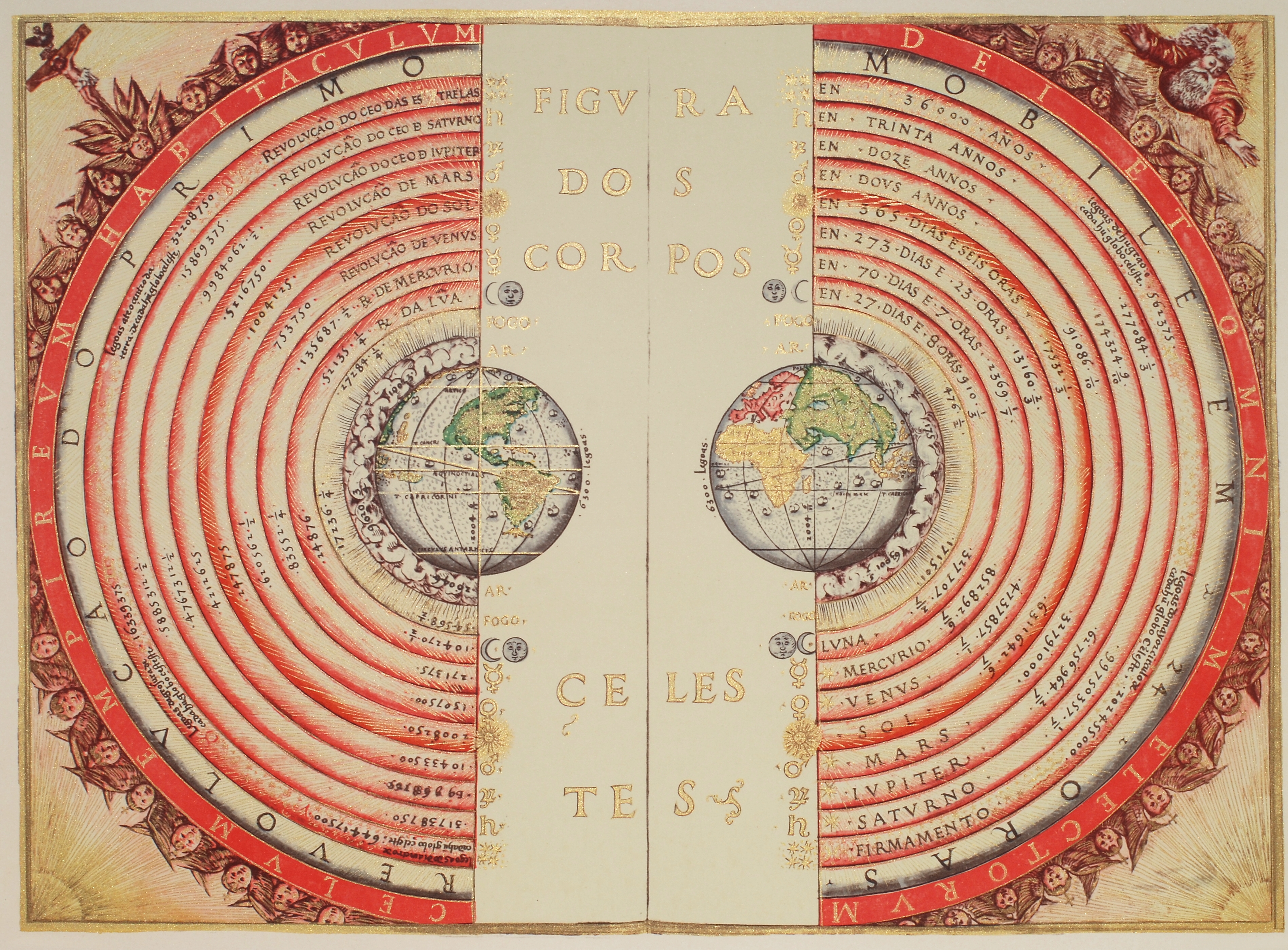
Of course there were the literalists who were genuinely upset about the Bible verses that said the earth was fixed and unmovable, but that wasn’t the biggest deal. geocentric model

Galileo didn’t hurt the Church’s science feelings as much as he hurt their theological feelings.

  • If the earth is not the center of everything, then man is no longer the central focus of creation.
  • If the earth is just one of innumerable planets in the universe, the earth is not special to God, and therefore man holds no special place in creation.
  •  Adam has no meaning! Noah has no meaning! All of the Christian story is lost!

(Karl Giberson discusses the theological implications of Galileo’s evidence on 17th century belief here).

The Great Sticking Point – the Evolution of Humans

Many Christians, faced with the scientific evidence and unwilling to believe in a vast conspiracy of deceitful scientists, are often willing to accept a very ancient earth and even the evolution of plants and animals.

But humans. That’s a problem.

The arguments against humans as part of the great evolutionary story of life on earth sound very much like the theological arguments of the seventeenth century:

  • If humans are just another branch in the evolutionary tree, we aren’t special to God.
  • What about Adam?
  • If we don’t have a real Adam, there can be no “fall of man”… and without the fall, there’s no need for Jesus.
  • All is lost!

How Can We Reconcile Human Significance and Evolution?

Because evolution is driven to a large degree by random mutations, are human beings just a blind, meaningless accident? In the biological history of the earth, there have been creatures that were vaguely similar to us, some were very similar to us, and some were not even remotely like us (p. 198).

consequences-of-evolution-388

Consider these three ways of looking at human significance in the context of evolution…

A God outside of time: to a Being unbounded by time and existing outside of time, is anything truly random? We have no idea how God and his purposes relate to time. An event that seems absolutely random (such as carbon production inside a distant star billions of years ago) becomes essential to building life on earth.

A God acting in time: if God sustains life through natural laws and processes, could not God create life using natural laws and processes? Genetic mutations are by their very nature unpredictable because they are initiated at the quantum level of the atom. At the quantum level, things are unpredictable, actually unknowable. It is conceivable that God could work undetected within natural laws, within the natural unpredictability of the quantum level and influence the evolution of life.

A God who allows freedom: all of creation, both animate and inanimate, has free will. A third way of understanding is that God has integrated freedom into the evolutionary process. God may have chosen not to specifically direct the winding pathways of evolution (Language of Science and Faith, p. 200), but to let the process unfold.

Please note that scientific evidence supports this very important fact: evolution did not require any outside tinkering or intervention.

Francis Collins sums it up beautifully:

If God chose to create you and me as natural and spiritual beings, and decided to use the mechanism of evolution to accomplish that goal, I think that’s incredibly elegant. And because God is outside of space and time, He knew what the outcome was going to be right at the beginning.

Were Humans an Accident?

The late paleontologist Stephen J. Gould believed that human evolution was completely a happenstance occurrence. For instance, Gould argued that consciousness would have never evolved if a meteor had not wiped out the dinosaurs, allowing for the rise of mammals.

Interestingly, Simon Conway Morris, a Cambridge academic and highly respected evolution scientist (and a Christian) highlighted by Gould in his work, opposes Gould’s “happenstance” view.

Conway Morris supports the idea of convergence in evolutionary history. Convergence means that there are a limited number of ways to solve a biological problem. The best example of convergence is the eye.

Humans and octopuses do not share a close common ancestor, yet the eyes of humans and octopuses are nearly identical. On two very separate evolutionary paths, the process of evolution solved a problem (the need for vision) in the same way. Throughout evolutionary history, the eye has developed independently at least seven times (Language of Science and Faith, p. 203).

octopus wearing glasses

According to Conway Morris, the playing field of natural history is tilted toward big brains, remarkable eyes, consciousness, language, and complex thought. Conway Morris’ research supports that these traits would inevitably emerge from the evolutionary process:

Contrary to popular belief, evolution does not belittle us. As I argue, something like ourselves is an evolutionary inevitability, and our existence also reaffirms our one-ness with the rest of Creation (p. 204).

So what do we do with Genesis?

Genesis is an ancient story, passed down, and finally written down in its current form during the time of post-exile Israel. The purpose of Genesis is not to give a biological description of how humans came to be. The purpose of Genesis is to say Who did the creating – God – and that humans are part of God’s plan and purpose.

How does the story of Adam and Eve fit into a billions-of-years-old earth and humans originating in Africa hundreds of thousands of years ago? It might surprise you to know that over the years, there have been many interpretations of the Adam and Eve story among Christians – some literal, some theological.

adam-and-eve

A literalist reading of the creation story says that Adam and Eve were specially created and that all humans are descendants of this first couple. There are many problems with a literalist reading of the creation story. Narrative problems include the two conflicting creation stories in Genesis, Cain’s wife and where she came from, and the origin of the people who were out to kill Cain, and the origin of the people populating the city built by Cain. Scientific evidence makes a literal reading even more problematic: recent DNA studies demonstrate that modern humans came from a population of thousands, not just two. In addition, both DNA and fossil evidence demonstrates the interrelatedness of humans and all other animals.

One non-literal interpretation of Genesis is the “everyman” interpretation. This view holds that the Adam and Eve story is really the story of us all. The “fall” wasn’t just about Adam and Eve, it was about all humans’ eventual rejection of God and succumbing to our flawed and sinful natures. A non-literal interpretation posed by Old Testament scholar Peter Enns suggests that Adam is the beginning of Israel, not humanity. Enns’ book The Evolution of Adam explores this idea in depth.

Some Christians (including C.S. Lewis) integrate science with a historical view – humans evolved as the science evidence indicates, and at some point God entered in to a special relationship with humans and made them his image-bearers. It is of course all speculative, but this view fits with either an Adam-and-Eve-are-real-people scenario or an Adam-and-Eve-are symbolic-of humanity scenario.

Seeking to populate this otherwise sterile universe with living creatures, God chose the elegant mechanism of evolution to create microbes, plants, animals of all sorts. Most remarkably, God intentionally chose the same mechanism to give rise to special creatures who would have intelligence, a knowledge of right and wrong, free will, and a desire to seek fellowship with Him (The Language of God, Francis Collins).

Christianity survived the fall of a geo-centric solar system, and Christianity can survive human evolution.

And now….

This:

This is probably my favorite video clip of all time. How can you beat a musical combo of the preeminent modern New Testament scholar, N. T. Wright, world-renown geneticist Francis Collins, and the Beatles?

Please watch….

It’s a funny, beautiful, and truthful ending to this discussion:

N.T. Wright sings “Genesis”

This series is a chapter by chapter discussion of The Language of Science and Faith by Karl W. Giberson and Francis S. Collins, with my commentary and my observations.

****************
I believe that the heavens declare the glory of God.
I believe that day after day the cosmos pours forth speech and night after night the cosmos reveals knowledge.
I trust that the evidence and knowledge that is revealed is true because the Creator of the cosmos is Truth.

What is the Fine-Tuning of the Universe?

Apparently the universe knew we were coming.

sherlock_holmes

Freeman Dyson, one of the greatest physicists of the twentieth century, said this about the physical laws of the universe:

The more I examine the universe, and the details of its architecture, the more evidence I find that the Universe in some sense must have known we were coming (The Language of Science and Faith, p. 195).

The physical laws of the universe appear to be designed precisely to support life. In addition, the beginning of it all – the Big Bang – appears to have transpired precisely in a way that would result in life.

Nobody debates this fact – the universe is finely tuned to support the appearance and the development of life.

What is the “fine tuning” of the universe?

There are a myriad of constants in our universe. These constants are numerical values that always hold true – for example, the speed of light.    speed limit of light

There are also forces in nature: the strong nuclear force, the weak nuclear force, the electromagnetic force, and the most familiar of all, gravitational force.

If any one these myriad factors – the constants or the forces – differed even slightly from their actual values, life in the universe would be impossible.

Fine Tuning – Three Examples

carbon  The most important building block of life is the element carbon. Carbon, present in all living things and absolutely essential to life, is a highly improbably element.

But before we talk about carbon – the building block of life – we need to first talk about stars.

Most of the heavy elements in the universe were formed in stars through a process called fusion. Fusion happens when two or more atomic nuclei collide at a very high speed to create a new, heavier element. When fusion occurs, energy is released. Fusion is what fuels the stars and makes them shine:

Twinkle Twinkle Little Star 
I know exactly what you are 

 Opaque ball of hot dense gas 
Million times our planet’s mass 
Looking small because you’re far 
I know exactly what you are 

Fusing atoms in your core 
Hydrogen, helium, carbon and more 
With such power you shine far 
Twinkle twinkle little star 

Stars are primarily composed of the lightest element, hydrogen.

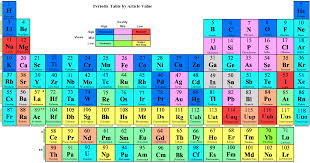
In intensely hot stars, two hydrogen atoms fuse to form helium. Two helium atoms fuse to form lithium, two lithium atoms fuse to form beryllium, and so on as we march across the periodic table.

  periodic table  .

Some fusions are much more improbable – carbon is one example. In order for carbon to form, three helium atoms have to collide and fuse. And if that wasn’t hard enough, energy levels in the colliding atoms must match up in order to form carbon. If three helium atoms happened to collide under normal circumstances, the energy levels would not match up. The helium atoms wouldn’t stick together and the atoms would fly apart before they could actually form an atom of carbon. In the production of carbon, the strong nuclear forces and the electromagnetic forces collaborate in a delicate-just-so dance, working together in a collaborative way that allows an improbable window of opportunity for the helium atoms to stick together and form an atom of carbon.

The slightest change to either the strong or electromagnetic forces alters the relevant energy levels, resulting in greatly reduced production of carbon. And carbon, of course is essential to life, so reducing its production dramatically reduces the probability that the universe will turn out to be habitable (p. 182).

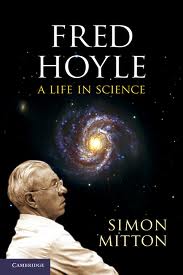
Fred Hoyle, one of the twentieth century’s most renowned scientists, called this phenomenon the carbon resonance.

A commonsense interpretation of the facts suggests that a super-intellect has monkeyed with physics, as well as with chemistry and biology, and there are no blind forces worth speaking of in nature. The numbers one calculates from the facts seem to me so overwhelming as to put this conclusion almost beyond question. (Language of Science and Faith, p.182).

hoyle    (Here’s an interesting side note to the Hoyle quote – Hoyle was an agnostic and in no way wanted to invoke God as an explanation.)

Gravity is the force that attracts you to the surface of the earth (and vice-versa). Gravity is the force that keeps the moon in its path and keeps planets in orbit. Gravity is the force that attracts everything in the universe to each other.

Immediately after the big bang, all matter was randomly distributed – no stars or planets – just individual atoms swirling about in the darkness of space.

Enter gravity.

As matter expanded, gravity began to tug on matter, clumping it into bits, then bigger bits, and bigger. Eventually, matter clumped together as stars and galaxies.

If the force of gravity had been just infinitesimally greater, gravity would have pulled everything back together again, crashing in on itself.   If the force of gravity had been just infinitesimally smaller, matter would have been scattered throughout the universe so loosely that stars would have never formed. Without stable stars like our sun, there can be no habitable planets capable of supporting life.

Paperclip-300x200  Just how exact must the force of gravity be in order to have the universe we have? A paper clip weighs one gram. If gravity was changed so that you weighed one-billionth of a gram less or one-billionth of a gram more than you do now, our universe would have no stars, galaxies, or planets.

None.

No planets, no life.

Goldilocks and the Big Bang. Just after the bang of the big bang, things proceeded in a way that would pave the way for life. For example, if the rate of expansion had been greater, matter would have been so diffuse (spread out) that gravity would not have been strong enough to gather matter together into stars and galaxies. If the rate of expansion had been any slower, gravity would have pulled everything back into a black hole. The expansion rate was “just right” – just like Goldilock’s porridge – not too fast, not too slow.

goldilocksCan We Explain Fine-Tuning Without God?

Because humans exist, the laws of nature are obviously conducive to life. Otherwise, no one would be around to notice.

Right?

This is typically the rationale given by those in the “no God” camp. But is it a satisfying explanation?

Here’s an analogy given by philosopher John Leslie (Language of Science and Faith, p. 187): Suppose you are to be executed by firing squad. There you stand, blindfolded, and all of the guns fire. Every shooter misses, and you survive.

What do you think about your situation?

Do you think: Well of course all of the shots missed. Otherwise, I wouldn’t be here to notice that I am still alive.

Or do you suspect that something’s up? Something went on behind the scenes? A plot to save you, maybe? Why might such an unlikely event occur?

Our universe appears to have something that went on “behind the scenes”. Intellectual curiosity should lead us to at least consider explanations as to why so many unlikely events converged at the instant of the big bang.

Inflation is another God-free explanation for the apparent fine-tuning of the universe, but this theory simply pushes the fine tuning back a step, it doesn’t eliminate it.

Finally, there is the multiverse explanation. This explanation says that there are an infinite number of universes with infinite combinations of conditions and this is the one we happen to live in. There is not wide-spread support for this idea. Interestingly, Stephen Hawking has said that the multiverse idea is really the only way around the apparent fine tuning of the universe.

Proof of God?

Obviously we can’t prove God, but the fine-tuning of the universe definitely points to a Designer/Creator.  Giberson and Collins (p.190) enthusiastically endorse the idea that the universe is intelligently designed (not to be confused with the “Intelligent Design theory” that opposes evolution). The numerous forces, conditions, and constants that must be “just so” provide a compelling argument that a Creator brought matter into existence, governed by finely-tuned natural laws, resulting in a universe where life could develop and thrive.

Modern scientific understanding of physical laws and constants were not what the psalmist had in mind when he wrote:

Creation is maintained by your rulings, since all things are your servants (119:89-91 JB),

nor was Paul speaking as a physicist when he described the Creator-Christ as the one who holds all creation together (Colossians 1:17).

Science can define, observe, describe and articulate natural laws; this does not diminish God as the author and sustainer of those laws.

This series is a chapter by chapter discussion of The Language of Science and Faith by Karl W. Giberson and Francis S. Collins, with my commentary and my observations.

****************
I believe that the heavens declare the glory of God.
I believe that day after day the cosmos pours forth speech and night after night the cosmos reveals knowledge.
I trust that the evidence and knowledge that is revealed is true because the Creator of the cosmos is Truth.

Why is Darwin’s Theory So Controversial?

Why is Darwin’s Theory So Controversial?

Elizabeth Gilbert, bestselling author of Eat, Pray, Love recently published a new novel – The Signature of All Things. The book is fictional, but the historical setting is not. The book follows a nineteelizabeth-gilbert_72140_600x450enth century female botanist, Alma Whittaker.  Through her own observation, collection, and study, Alma, like many natural scientists of her day, came to understand that life on earth had changed drastically – evolved – over time.

Here’s the catch – the fictional Alma (and her non-fictional counterparts upon whom she was modeled) – lived and worked before Darwin.

Evolution Before Darwin

Prior to Darwin’s Origin of Species in 1859, the idea of the development and evolution of living things over time was widely discussed – and accepted – by scientists and natural philosophers. What Darwin did was to articulate the process (natural section) by which these changes occurred.

The vast amounts of time needed for evolution was not initially a sticking point for Christians. The idea of a very old earth was widely accepted before Darwin, even among conservative Christians. Advances in geologic science and a rapidly growing roster of fossils pointed to an ancient earth – and nobody was really upset about it. For most Christians, an old earth did not contradict the Genesis creation story.

An old earth was usually reconciled with a literal reading of Genesis in one of two ways: the day-age theory or the gap theory. Day-age theory said that the “days” of Genesis were not 24-hour days, but instead were epochs of geological time. Gap theory said that there was a great gap of time between God’s creation of the heavens and the earth and the creation week found in Genesis. In light of scientific data, many nineteenth-century Christians adjusted their reading of Genesis without widespread upset.

Reaction to Darwin – Then and Now

Initially, Christian opposition to evolution was focused in two areas.

The non-directed (random) nature of the evolutionary process was seen as purposeless and without meaning. Actually, the thought of animals and plants evolving was far less offensive to most Christians than the thought of a “meaningless” process.

The second point of opposition lay in the biblical scholarship battles of the day. Because religious modernists (the “liberals”) tended to be captivated by new science discoveries, they also tended to accept evolution. The very fact that liberals tended to accept evolution was reason enough for many Christians to deny it. Even so, by the end of the nineteenth century the evolution of species (except humans) was accepted by many Christians, including several conservative theologians.

Practically no one was arguing for a very young earth except the Seventh-Day Adventists, whose founder claimed a vision revealed to her that Noah’s flood was responsible for fossils.

Darwin, Evolution, and Twentieth Century Christians

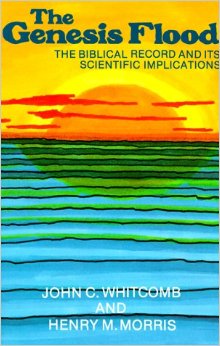
George MacCready Price, a self-taught geologist and a Seventh-Day Adventist, expanded the flood explanation in a series of genesis flood coverbooks in the early part of the twentieth century. In 1961, the flood/fossil idea was updated and was published in what would become the centerpiece book of the young-earth-creation-science movement: The Genesis Flood. Because of Sputnik (1959) and the subsequent push for improved science education in American schools, evolution as a topic began to appear in earnest in science text books.

headline sputnik

In response, The Genesis Flood school of thought caught fire and took off.

It soon became a matter of Christian orthodoxy to deny evolution and an old earth.

Groups like Answers in Genesis and The Institute for Creation Research have advocated “teaching the alternative” or  “teaching the controversy” (young earth/special creation/fossils from the flood VS evolution) in schools.

teach_the_controversy_by_ex_leper-d2xgnki

What Are the Challenges to Evolution?

Some questions about evolution were problems at one point, but have now been fully resolved. Not long after Darwin, physicists argued that the earth was only about 100 million years old, not nearly enough time for evolution to have produced the current variation in living things. It was assumed at that time that the earth began in a molten state and had been cooling ever since. Analysis of the rate of cooling from the heat remaining in the ground (volcanoes, geysers) revealed that the earth could not possibly be billions of years old (Language of Science and Faith, p. 162). Not long afterwards, radiation was discovered. Radiation has been releasing heat into the earth since the earth began, countering the cooling process. Radioactive elements are also a very reliable natural clock – because we know the amount of time needed for one element to decay into another, we can determine the age of rocks.

Long-resolved challenges to evolution like this are now only problems for those who are not current with scientific literature or who do not respect the literature.

Some questions about evolution are not really problems at all, but are premised on misunderstandings of science. A common argument against evolution is that evolutionary theory breaks the second law of thermodynamics. The second law states that everything becomes disordered over time. We see examples in everyday life – cars don’t get newer, they rust and corrode. Fruit doesn’t get fresher, it decays. Evolution seems to say just the opposite – simple, primitive cells evolved into the brilliant complexities of modern organisms.

Here’s the important part – the part that is misunderstood: the second law says that disorder increases in an isolated system. Almost every system in nature has input from the outside. Input from outside a system can produce order.

Here’s a familiar example: green plants and the process of photosynthesis. With energy input from the sun, green plants turn carbon dioxide and water into sugars. As long as the green plant has energy input from the sun, sugars will be constructed – order is increased.

Go to any elementary school science fair and I promise that right next to the kid who investigated “playing rock music vs. classical music to potted plants” you’ll find a junior scientist “investigating” what happens when you grow plants under a box in the dark. Take away the outside input, and the plant starts to decay – it becomes “disordered”. science-fair-projects-for-kids-growing-plants

Interesting to note that as the sun produces the energy that is used by plants to become more ordered, the sun itself is becoming more disordered.

As evolution unfolds on earth the sun becomes increasingly disordered and the total order of the solar system and the universe is still decreasing (Language of Science and Faith, p. 167).

Biological systems (living things) are not isolated systems, so the second law does not apply to them.

Some questions about evolution are unanswered…so far. Probably the most concerning unanswered question is about the origin of life itself. Evolution theory explains the development of life on earth. Evolution theory says nothing about the origin of life – that is a separate question. Scientists have a pretty good idea about when life appeared on earth (about four billion years ago) but no agreement on the how.

But – just because we don’t have a science explanation for how life emerged today does not mean that we won’t have one tomorrow. It is tempting to put God in our gap of knowledge: since we don’t know how life began on earth, it must have been a special miraculous intervention by God. Then what happens if tomorrow’s headlines announce that scientists have discovered how life began? Is all lost for believers in God?

Hardly.

If (or when) the origins of life are found, we will not have disproved God; we will have discovered the mechanism by which God brought life about on earth.

…God’s original and elegant plan for the universe may well have included the potential for life to arise without necessarily requiring later “supernatural” engineering to jumpstart the process. In this view, God’s sustaining creative presence undergirds all of life’s history from the beginning to the present (Language of Science and Faith, p.175).

Side note: Last week, Dr. Giberson, one of the co-authors of The Language of Science and Faith, debated a young earth creationist in an event sponsored by the Center for Creation Studies.

It’s lengthy, but very interesting. Here’s the linkgiberson debate

Dr. Giberson is a very patient man!

This series is a chapter by chapter discussion of The Language of Science and Faith by Karl W. Giberson and Francis S. Collins, with my commentary and my observations.

****************
I believe that the heavens declare the glory of God.
I believe that day after day the cosmos pours forth speech and night after night the cosmos reveals knowledge.
I trust that the evidence and knowledge that is revealed is true because the Creator of the cosmos is Truth.

Science and the Existence of God

Do you believe in God?

Have you ever been put in the spotlight and asked just that question?

640px-Lisa_on_the_witness_stand

You are on the spot now – What say you?

With biting humor, Bill Maher looked at modern belief in God in his 2008 documentary, Religulous. It is cleverly made, but quite often uncomfortable to watch. Why would any educated, intelligent person in the twenty-first century believe in God any more than they would believe in Santa Claus, Zeus, or a Flying Spaghetti Monster?

Can a Reasonable, Rational, Science-believing Person Believe in God?

 Common Arguments for the Existence of God

  • First cause argument: why is there something rather than nothing? Everything in existence was “caused” by something or someone. God is the “first cause” of everything and he started the chain of all other causes. This argument actually predates Christianity – it was proposed by Aristotle in the fourth century B.C.
  • Design argument: the universe displays intricate and complex design. Just as a complex machine or a fantastic example of architecture points to the existence of its designer, the universe also points to a designer (God).
  • If you can imagine it, then it is so: if it is possible for God to exist, then he exists. (I know- doesn’t make a lot of sense. This isn’t a very popular argument).
  • Love is real: and so is morality, beauty, and loyalty. The non-physical aspects of life cannot be completely explained in a purely materialistic way. There is a reality (God) that is not material or physical.
  • Logic argument: some things are always true and this truth does not depend on human minds. This argument says that things like logic, science, and ethics do not make sense in the absence of God.

The sometimes uncomfortable truth is this: we cannot absolutely prove God’s existence. None of these arguments settles the case once and for all. Some of the arguments are flawed.

All the same, reasons for belief in God can be meaningfully discussed and taken as evidence that he exists.

The Problem of Evil

How can a good, loving, and all-powerful God allow evil and suffering in the world?

 Of all the challenges to faith, few are greater and have caused more believers to abandon their faith than the problem of evil (The Language of Science and Faith, p. 127).

Actually, the problem of evil is a conundrum for both believers and nonbelievers.

For nonbelievers, the problem is truth. If truth is not absolute, then there is no absolute morality. “Right and wrong” are simply artifacts of culture and human social development. In the absence of an absolute morality, no one can complain about the unfairness of any kind of suffering or injustice….it just is what it is.

For believers, the problem is inconsistency. Believers must reconcile the apparent conflict between a loving, all powerful God in charge of a world filled with Holocausts, human trafficking, terrorists, disease, and natural disasters.

The Problem of Human Evil

Humans are free-willed beings. From a Christian perspective, free will is a gift from God that gives meaning to life. We were not created as programmed robots that act in a predetermined way. We can choose to accept the love of God – or not. Free will also means that humans are a primary source of evil in the world. Humans are free to choose murder, theft, torture, trafficking, and lies.

Only an actual choice – real freedom – can give us a genuine relationship with God. But with real freedom, evil is always an option.

The Problem of Evil in Nature
plague

Yersinia pestis

Disasters  in the natural world cause untold suffering. Polio cripples and malaria kills. People die in tornadoes, hurricanes, earthquakes, and floods.

And on a daily basis, vipers have poison, bees sting, mosquitoes bite, and cats torture their prey before they kill it. Predator and prey in the animal kingdom, where death and suffering are ironically the way of life.

Some Christians do back-bends with their theology in order to reconcile the violence of nature with a good Creator God and the perfection of Eden. A popular explanation is that no animals were carnivores prior to the sins of Adam and Eve in the garden.

We have to suppose that every animal on the planet had its way of life dramatically transformed by the curse. Sharp teeth and poison glands – and the genetic code to produce them – had to pop into existence, since animals were now going to start killing each other for the first time (Language of Science and Faith, p. 131).

vegitarian lion

Quite simply, there is just no evidence in the fossil record of carnivore-style teeth suddenly appearing – and teeth fossilize very well. Additionally, natural laws such as gravity, force, and tectonic plate movement must be suspended in order to support the supposition of a perfect, nonviolent world: no animal deaths from falls, no squishing an insect with a carelessly placed hoof, no earthquakes or volcanoes.

Overwhelmingly, it is clear that death, suffering, and natural disasters were commonplace billions of years before humans appeared.

 The Problem of Evil and Intelligent Design

Intelligent Design (ID) is an explanation of origins that is touted as an alternative to evolution. The Intelligent Design argument says that the exquisite and complex features of creation point to a Designer (understood to be God) who individually designed each component of the natural world. Intelligent Design highlights helpful components of nature such as the human eye, the human blood clotting mechanism, and interesting things like the “cute” little motorboat-like flagellum of bacteria (p. 132).

Intelligent Design proponents, however, do not talk about the more sinister “designs” in nature: the incredibly well-designed and successful AIDS virus or the really efficient bacteria that killed millions with plague. And then there is the especially charming species of wasp that lays its eggs in a caterpillar. When they hatch, the baby wasps nourish themselves by eating the internal organs of their hosts in the order that ensures their hosts live as long as possible (Language of Science and Faith, p.130).

Some have suggested that Satan is responsible for the creation of the distasteful things in nature, but this is elevating Satan to the level of creator (p. 133).

I can’t go there.

How Might Evolution Help Faith?

By faith we believe that all creative power comes from God, but this power can be wielded by nature to form, build, shape, and create. Tides, rivers, wind, even gravity are constantly forming and reforming the earth.

In the most minute sphere of the physical world – the subatomic level – things really get interesting. Identical electrons will “choose” to behave in different ways. This behavior is random and is not predictable.

…many processes in nature exhibit a genuine unpredictability that looks, for all the world, like freedom (p. 134).

Analogous to the freedom given by God to humans is the freedom given by God to all creation. God does not micromanage human behavior, and the result is that we humans abuse our freedom and bad things happen. Bad choices are the result of autonomy. Likewise, God does not micromanage nature. In its autonomy, nature will produce some bad designs (from a human perspective).

Humans and nature have been granted freedom by their Creator – neither are programmed robotic creations.

So why doesn’t God intervene? No one can explain why God doesn’t stop great evils like the Holocaust. No one can resolve the problem of when and why God chooses to intervene in human history or in nature.

It does help, however, to realize that genuine freedom – the very real freedom that allows us to love God – has to allow evil.

If God constantly intervened and blocked the consequences of the moral choices of humans every time they lead to evil, moral responsibility would disappear (p.140). We would be free to lash out, harm, and even murder those who anger us, confident that God would swoop in and undo the results of our wrath.

If God constantly intervened and blocked the consequences of natural laws, our world would be unpredictable and science wouldn’t work.

Moral Laws and God

Just as some use evil to argue against the existence of God, the unfairness of evil can be interpreted as support for God’s existence. Whenever we complain about the unfairness of a situation like cheating, bigotry, or third world debt, we are appealing to some sort of higher standard – the way things “should be”. If we are nothing more than an assemblage of chemicals, why should it matter?  One molecule owes nothing to other molecules. Our moral sense of right and wrong transcends our material selves.

It has been suggested that our moral selves evolved as our big brains evolved. It is true that caring and helpfulness and other positive traits are beneficial and could have evolved to aid human survival. It is entirely possible that God could have used natural processes to produce moral standards in humans, but there is currently no compelling theory for this (Language of Science and Faith, p. 143).

The prevalence and universality of moral standards is completely consistent with the existence of God. 

If we accept the reality of such moral laws, then we must ask about their origins. God is a reasonable conclusion to such exploration (Language of Science and Faith, p. 144).

Evolution Helps Faith – Really

The subject of evolution makes a lot of Christians really nervous. Many smart, thoughtful believers consciously avoid even investigating evolution for fear that science is corrosive to faith.

In addressing the age-old question of “how can a good God exist when there is so much evil in the world”, science is a positive. Evil, both human and natural, are the results of the freedom in creation. God is not the cause of evil.

Our universe appears to have a beginning. It appears to be fine-tuned for life. Our universe appears to have a place for love and purpose. To deny the existence of God is to say that the universe is not really as it appears – it’s all an illusion.

The fool says in his heart, “There is no God.” Psalm 14:1

This series is a chapter by chapter discussion of The Language of Science and Faith by Karl W. Giberson and Francis S. Collins, with my commentary and my observations.

****************
I believe that the heavens declare the glory of God.
I believe that day after day the cosmos pours forth speech and night after night the cosmos reveals knowledge.
I trust that the evidence and knowledge that is revealed is true because the Creator of the cosmos is Truth.